Friday, 3 January 2014

Shooting Ingrid Bergman


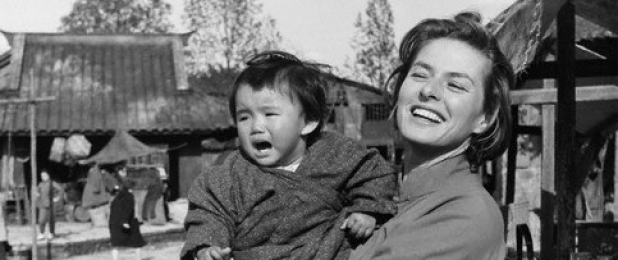
Francon goes to Hollywood: Ingrid Bergman at the head of Nant Francon. Her expression perhaps suggesting a recent visit to Bethesda.

Moel Hebog’s snow dusted summit had finally shaken off its early morning cloud cap and the luminous glow of the lazy winter sun was gradually lifting the land out of February’s lengthening shadows . At least the short early morning trip from Nantmor to Beddgelert, in an open topped WW2 Jeep, promised to be a dry affair, if guaranteed to suck the marrow out of the gnarliest  bones. For Ruth Janette Ruck-wife of the rock climber and smallholder Paul Orkney Work-the journey had been unplanned the preceding evening until she took the call. At first she thought it was a hoax. But who would invent such a scenario and who did she know with an accent like that?  No...the caller appeared to be genuine even if his request bordered on the surreal.  For the next four months, Ruth Janette Ruck would be propelled into a world which was light years removed from the hum-drum  of  a smallholders life in 1950’s rural north Wales.


Ruth Janette Ruck and her husband ran a small mixed holding on the southern slopes of Moel Dyniewyd; a Moelwyn outlier which contained the delightful valley of Nantmor. A quiet land  laced with small farms, grey chapels and abandoned nettle limed ruins, cast amongst river meadows and steeply inclined fields where only the native sheep could cling on. Broad strands of sessile oak woodland divided the fertile lower meadows from the bare mountain slopes above. Unlike the gaunt bare valleys of Northern Snowdonia, Nantmor’s westerly location-close to the sea- gave it a fatter, richer aspect and character.
The Chinese City of Yangchen created on the slopes of Moel Dyniewyd


The telephone call that Ruth had taken had come from a representative of Hollywood movie giants, Twentieth Century Fox. Ruth and her jeep were needed to transport members of the film direction team on a location shoot for a movie which the company were planning to shoot in North Wales. Although the film was set in the mountains of Northern China and although the company had scoured various locations in the Far East including Hong Kong and Taiwan, it was finally decided that the mountain areas within the Snowdonia national park were closest in character to the story’s location.

The film ‘The Inn of the Sixth Happiness’ was based on the real life story of Gladys Aylward, a self appointed Christian missionary who after being turned down by official agencies, managed to fund her own journey to China where she procured a placement with an elderly female missionary who ran a Christian guest house in the remote the inland city of Yangchen, in the mountainous province of Shansi.

It was a dark period in China’s troubled history. The country was in the midst of it's second Sino-Japanese war  In the midst of this chaos, Gladys Aylward’s greatest achievement- and the central focus of the planned film- came when she guided a party of over 100 children through the mountains to escape the advancing  Japanese army who were carrying out a bloody campaign under the  standard of the rising sun.  Her epic trip through the mountains of Shanshi  was a feat of courage and endurance for which she received official commendations from both the UK and the PRC governments.


In real life, Gladys Aylward was a short rather dumpy woman with a rich cockney accent. Naturally, Hollywood, as ever sensitive to authenticity, cast a tall, beautiful Swedish woman-Ingrid Bergman-in the role. She would be supported by Robert (Mr Chips) Donet playing a Chinese mandarin and Curt Jurgens as a mixed race officer in the People’s Army.  The Inn of the Sixth Happiness being a Hollywood movie couldn’t resist throwing some romantic interaction into the film and throughout the movie, the Bergman/ Jurgen characters simmer in their passion. A highly unlikely scenario in the circumstances and one which the real Gladys Aylward absolutely denied.


Ruth arrived at the Royal Goat Hotel in Beddgelert and describes the early morning scene.... There was the quiet of early morning with the smoke of newly lighted fires pluming upwards, and Will Bryn Felin going from door to door with the morning milk. The only thing which jarred with the timelessness of the scene was the limousine parked outside the hotel with a uniformed chauffeur in attendance.... Eventually, a contingent of movie makers emerged and joined Ruth and her sheepdog Mit in the boneshaker and off they went. Covering all points of the compass and exploring every narrow lane and axel snapping, sump splitting track between Beddgelert and Nant Francon.


Eventually the director Mark Robson and his team settled upon Nantmor itself as the main location for set construction, where, according to Janette Ruck This Chinese city of Wangcheng was beautiful.... It fitted perfectly into those wild surroundings and lent splendour to the great sweep of Moel Hebog behind it. Other sets were being built too. A complete Chinese village appeared on the terraced workings of an old copper mine near Beddgelert, and a graveyard with plaster monuments in the village of Llanfrothen.


‘Wangcheng’ the main focal point of the outside filming was constructed on the craggy slopes of Moel Dyniewyd. The main crag of Dyniewyd is the site of one of Paul Work’s best routes, the delightful ‘Christmas Climb’. A route which was one of Menlove Edward’s last climbs, completed with its progenitor a few months before he committed suicide. Edwards was another one time Nantmor resident who lived just up the valley from Paul and Ruth in the tiny cottage of Hafod Owen, and whose ashes were scattered in the valley just months before the film shoot.


One of the other main film locations was the head of Nant Francon just beyond Ogwen Cottage where the film company were forced to base their activities. Access along the old road which runs parallel to the A5 was impossible to all but 4x4’s at the time. It was at this location- where the hillside runs up to and  spills over in Cwm Idwal -that the main filming took place which detailed the exodus through the mountains. Much of the battle footage was also filmed above Nant Francon and below the West Face of Tryfan. Eagle eyed film watchers familiar with Snowdonia will watch the movie with a wry smile as Ingrid Bergman and Bert Kwouk - best known perhaps as Peter Sellers Pink Panther accomplice Cato - lead their ragged caravan under the shadow of Y Garn and the distant Devil’s Kitchen.


The small village of Beddgelert, would have been a  fantastical surreal place for anyone passing through at the time with bloody Japanese soldiers, Chinese peasants and panniered  war horses wandering up and down the high street . A High Street alive with local, American and Scouse accents. Most of the Chinese characters including the Chinese child refugees were recruited from Liverpool’s Chinese community. Back in Ogwen, Ruth continued her role as a cast and props runner in her Jeep. Regularly running Ingrid Bergman up from Ogwen Cottage to the shoot location in her increasingly clapped out and gradually disintegrating boneshaker. Thankfully for Ruth, the film company had by now commissioned half a dozen extra Land Rovers to relieve the burden.


Back on Dyniewyd, the unwitting visitor cresting a neighbouring hill would have witnessed a sight which was guaranteed to knock them back on their heels. Japanese bombers strafing a impressive oriental walled city as peasants ran from the rice fields for their lives. Below the walled city, hundreds of extras and crew mingled out of shot on the mountain’s lower slopes. Down the road in the Aberglasllyn Pass, the film crew shot the river crossing scenes with Ingrid Bergman and Bert Kwouk leading their young Scouse charges through the fast flowing waters of the Afon Glasllyn.


By late June the film was in the can. In Ruth’s words... It seemed hard to imagine the countryside with no cars and people blocking the roads, no curly eaved pagodas on the hills, no sampans floating on the quiet waters of Llyn Dinas. The end came. The children left first. The vans, Lorries and buses went home. The casual goodbyes of constant travellers were said and the film makers slipped out of our lives. A few men were left to demolish the sets, but in a short time these too had finished, had loaded their last truck and departed. There was not a fragment of pagoda, not a bamboo pole, not a rice bowl left to tell us that China had ever been to Wales. The turf was replaced, the rubbish gathered, the hills restored to the sheep and mountaineers and the grey stone villages in the valley were quiet again.......I turned again to work which was governed by the sun and moon and the slow revolutions of the seasons.


An old climber once told me though, that years later you could still happen upon a ‘curly eaved’ Chinese building in the hills around Dyniewyd so perhaps the set managers were not quite as diligent as Ruth Ruck suggests? Sadly, in my many visits to this beautiful area, I have never come across so much as a sandal or chopstick.


The film was released in 1959 and became one of the year’s highest grossing films. Its appeal continues to this day and despite it very much being stylistically of its time, modern film fans still consider it something of a classic of the genre. For Gladys Aylward, the central character, the film with its romantic undertones was not to her taste and she refused to be associated with it or exploit its success by giving interviews or attend screenings.Ruth Janette Ruck  returned to the smallholders life and wrote two books which anticipated the escape to the country/good life boom by several years with her Faber & Faber published Hill Farm Story and Place of Stones. An essay ‘Wild Mountain Time’ appeared on Footless Crow which contains a potted climbing biography of her partner- Paul Orkney- Work. Ingrid Bergman died aged 67 in London.


 John Appleby:2014

Sunday, 29 December 2013

Hold the front page


Gently does it...The Temptation of Saint Julitta:Llynau Mymbyr, North Wales

Apologies if you dropped in expecting a regular Friday feature. Like millions of other people, I'm otherwise engaged in family affairs over the holiday period although I do have a new, previously unpublished article ready to slot in in the new year.So...thank you if you've been catching the site regularly and be aware, I'm always looking out for new material so perhaps you may have an essay or two gathering dust in the bottom of a drawer or buried in your computer files that you think would be of interest. Please get in touch via the email address on this page. Material does not have to be entirely related to the great outdoors as the site does on occasion publish art and environmental features. You can also keep in touch with what's going down through the Footless Crow Facebook and Twitter pages. All the best for 2014.
JA

Friday, 20 December 2013

A little low practice on the peaks


For most people "the Alps" are an image of ice-white teeth rearing stupendously against the sky. An alp with a small "a", the original core of the word, is a steeply sloping meadow in the mountains. I have walked or driven past many of these on the way to climbing the fantastical limestone towers of the Dolomites, where families were raking hay on slopes dotted with heavy-timbered barns like arks.
The Alps show their tectonic origins beautifully as you fly across eastern France and western Switzerland on the way to Italy - a sea of rock thrust up as the Earth's crust buckled. Snowfields drape their eastern sides, bleached herbage tries to grow on their western slopes, and the huge culminating massif of Mont Blanc merges its linen whites with those of the clouds.

So the Alps were made by the Earth, not by "the English". What the first modern (ie 18th-century) travellers from France, Italy, Switzerland and Britain found among these highest lands in Europe was a dream-like wilderness of pinnacles, glaciers and cliffs, seamed by valleys which peasants inhabited with their flocks. These farmers lived on milk and months-old bread, and made cheese for distant markets. In their houses, and in some of the inns, living room was shared with the animals.

The wine was bitter, the mutton stank, the straw beds were rife with fleas. In remote valleys people were plagued with goitre and cretinism because of an iodine deficiency. When the first women climbers omitted to put skirts on over their breeches on returning to the villages at night, they were stoned. The super-civilised Alpine Club was little better: an early woman climbing writer had to publish in its journal under a male pen-name and gentleman climbers cut the ladies dead in the streets of Zermatt.

So the climbers came, professional guides and men of private means, scientists and academics, doctors and priests and lawyers, carrying barometers, thermometers and crates of wine (on porters' backs) to the highest summits and over storm-blown passes. By 1815, the tracks round Chamonix were so crowded that tourists were advised to avoid peak hours.

The inns and roads and bridges improved. Railways were built up extraordinary gradients and through the roots of the mountains - the St Gotthard tunnel runs 6,000 feet below the ridge. The "white leprosy" (Ruskin's phrase) of the hotels transformed peasant villages into international resorts. Today there are 2,000 cable-cars and ski-lifts in Austria alone (25 in 1939), Zermatt has beds for 17,000 visitors, St Anton 300 ski instructors. In the Alps as a whole there are 600 resorts and 41,000 ski runs, able to handle 1.5 million visitors an hour.

I was dismayed, as much as anything, at the physical suffering, the desperation, and the bad blood that plagued so many people as they took part in what was supposed to be either a high-minded quest or an exhilarating pastime. I am happiest among the high lands myself, and find low lands a come-down with their sticky earths and sluggish waters. The trouble with the extreme high ground is that it is almost too much for human nature.

Edward Whymper, first person to climb the Matterhorn, was a man of extraordinary grit and purpose, a brilliant way-finder, a most incisive writer, and a draughtsman so good that his drawings leave you with no pressing need for photographs. When he got back to base after a 200-foot fall on the Matterhorn and a 4,800-foot down-climb in pitch darkness, he "slunk past the first cow sheds, utterly ashamed of the state to which I had been brought by my imbecility", and was then treated by having vinegar and salt rubbed into his many head-wounds. When his great rival in the "race" for the Matterhorn, John Tyndall, just failed to climb it, Whymper venomously disputed the exact high-point Tyndall had reached and Tyndall responded by virtually accusing Whymper of lying about who said what to whom when the climbing parties were organised.

When Whymper reached the summit in 1865 and saw a rival Italian party far below, he and his mates trundled rocks down the mountainside: "The Italians turned and fled". Then came the famous fall, which killed four of Whymper's party. When three of the dead were found, the guide among them, Michel Croz, "was missing the top half of his head and was identified only by his beard and by a rosary cross which the Reverend Robertson dug out of his jaw with a penknife".

Is this really the activity which was supposed to do so much for the inner self? Leslie Stephen, excellent scholar-critic and Alpine pioneer, wrote that that "If I were to invent a new idolatry... I should prostrate myself, not before a beast, or ocean, or sun, but before one of those gigantic masses to which, in spite of all reason, it is impossible not to attribute some shadowy personality. Their voice... speaks in tones at once more tender and more awe- inspiring than any mortal teacher. The loftiest and sweetest strains of Milton or Wordsworth may be more articulate but do not lay so forcible a grasp upon my imagination."

 I almost endorse that, although "personality" is rather fanciful. The fact remains that grappling with the ice, the often rotten rock, and the violent weather of the highest ranges, and handling the fierce egotism of the people competing to get up them, makes a record at least as ugly as it is inspiring.
David Craig: An extract from an article which appeared in The Independent.Dec 30th 2000
 

Friday, 13 December 2013

New Age Grade Slip


As a teenager I climbed HVS at pretty much my top grade. The legends soloed Vector down at Tremadoc and Ed Ward Drummond put up Great Wall on Cloggy. They were legends and god like in their fearlessness and we were mere mortals bumbling around the lower order higher grades.We bumbled around so much that I used to say that “if I could lead it, it was HVS, and if I fell off it was Extreme”.
 

The only bolt in the UK at that time as I recall, was somewhere on Cloggy- someone correct me if this wasn't the case- and there were no climbs on Malham Cove because there was not any pro that worked there at all. In fact, cams had not yet been invented and a well placed Moac was something that you could moor the QE2 up to.
 

Time shifts; I move to hot Australia and the decades pass. On doctors orders I return to rock climbing and buy a new pair of climbing slippers- high tops are no longer cool- and a new rack of hexcentrics and cams. Wearing a helmet that doesn’t protect the nape of my neck (what happens if I get hit on the head by a rock when looking down?) I venture forth to the cliffs and begin stumbling upwards again.

Several years and many hundreds of dollars in gym fees later, I stagger gloriously up a ring bolted Ewbank graded 21 and then look at the grade comparison - E2? Blimey dandy, that’s two grades harder than my best at the age of nineteen.Is the 5.10 rubber on my resoled, low cut climbing slippers that much stickier? Are my resin hardened and white chalked fingers that much stronger than my brick wall trained teenage fingers?
 

Somehow my geriatric free teeth, wigs, glasses and bus pass mind will not accept this. There can only be one answer - New Age Grade Slip. Now there are lots of grading systems around- USA - 5.11 and all that,  Ozzie numeric and the extended British E system- but none of them really compute for me because they don’t reflect the personal reality of my distant climbing past.
 

In my youth the legitimate ascents of climbs were achieved in a number of ways. Sometimes by combining several of the methods detailed below.....


The Sewing Machine - (Now largely renamed as Elvis Leg) this technique is self explanatory and is typically the result of either fear, malconditioning, prior over indulgence or a combination of all of the above.


Shagging The Rock - As the name implies, much grunting and pelvic thrusting was involved in this technique as verticality rather than horizontality was slowly and very inelegantly achieved.


Upward Cycling - A method of ascending that saw legs and feet being used in a panicked, scrabbling fashion that gradually propelled the leader towards the top of the pitch.


Falling Upwards - Yup, similar to the above but including arms desperately windmilling towards the next safe ledge.


Steadily Ascending- Cumulative Terror - Fear, gradually increasing in direct proportion to the distance from the last stance and / or the last piece of decent trad pro that was inserted into the pitch.


Sometimes Steadily Ascending Cumulative Terror often switched into the next condition of the leader’s mental state:
 

Ledge Amnesia - On arrival on a stance there occurs a sudden realization that the previous pitch had been climbed with absolutely zero recollection of what was included in the pitch due to the active mind blanking out the awful terror that it had just encountered during the preceding minutes of leading the climb.

There may be more techniques that fall into to the above portfolio that have been lost as a consequence of the ravages of time,  but I think that you begin to see the general picture. Most of the time on bigger, harder climbs,my peers and I were in a heightened state of certainly fear, and sometimes terror during the act of ascending a climb. It’s different now, the pro is better, there are often bomb proof bolts everywhere and we delicately point our ballet dancer toes onto holds, cooly ascending our way upwards in a beautific and controlled manner.
 

In the past, my meager pocket money and wages enabled the purchase of just a set of four Chouinard Stoppers, two Clog Zero’s (one hand filed down) and a miniscule brass hex on a wire. I now carry perhaps 30 beautifully sculpted, anodized, drop tested and serial numbered wires that will fit just about anywhere, and a sequential rack of shiny cams that fit into previously hopeless parallel cracks with stunning geometric precision.


I guess the unprotected monster climbs are still out there waiting with dripping fangs festering in a gaping maw. (Has anyone done The Black Spring on Dinas Mot recently?) 

It’s perhaps just that a significant number of these horrors have probably been tamed by modern pro - or just plain vanilla glued and bolted-so, maybe you got conned into reading these words by the title of the article. But I leave you with just one simple thought:
 

Is there a place for a grading system that includes a narrative that highlights or brings to the attention of us mere mortals that there are still some climbs out there that are still truly “Trouser Filling”?....“HVS, 5b TF anyone?”
Michael Combley:2013 
 

Friday, 6 December 2013

Wilderness Works: Rock Paper Fire....review


The mountain anthology has been around almost as long as people have been climbing mountains. Think of club journals from august mountaineering institutions like the CC, SMC and F&R, where editors have collected the writings of several authors, and published them in one annual publication. Over the years commercial publishers have got in on the act and used experienced outdoor writers to bring together works which were deemed inspiring and entertaining. The success of the anthology depends of course on the imagination of the editor and their choice of works. Several anthologies I’ve read, appear to have been thrown together with quantity rather than quality in mind, while other seemingly slight volumes, have nevertheless worked by virtue of the quality within.


The last mountain anthology I actually enjoyed was one of these latter slim
publications, a small volume of works by mainly Scottish writers,edited by  Alec Finlay called ‘The Way to Cold Mountain’.  This quirky little book  which included writers like David Craig and Andrew Greig was light years removed from the 700 page blockbusters which seem to be aimed at readers who enjoy Bear Grylls books.


However, I’m delighted to have discovered an anthology which whilst not fitting into Cold mountain territory, is nevertheless rather a humdinger within the genre. Marni Jackson and Tony Whittome's edited Rock Paper Fire which is described as being ‘the best of mountain and wilderness writing’, and I certainly can’t argue with this qualitative element of the subtitle. Brought together through the Banff Centre’s Mountain and Wilderness writing programme, Rock Paper Fire offers 24 essays from 23 different writers including our own Niall Grimes and Andy Kirkpatrick. From the opening chapter where Canadian mountaineer Barry Blanchard offers a poignant essay on love and loss, through to skier, Ian Brown’s closing essay on winding down in later middle age which philosophically ends  with the lines- ‘We can still make our own trails instead of following someone elses’- all essays shoehorned between,succeed in capturing the readers imagination, despite being drawn from disciplines as diverse as sailing and hunting.


As you will have gathered, this is not a pure mountaineering anthology. The clue is in the ‘wilderness writing’ element of the sub title, although with pieces from the aforementioned Mr Kirkpatrick, Boardman-Tasker winner Bernadette McDonald, Steve Swenson and Alpinist editor Katie Ives, there is no shortage of climbing essays.No surprise to find many of the non climbing articles particularly fascinating and enjoyable. Christian Beamish chasing for shelter as a Pacific squall batters his tiny craft; the perfectly named Wayne Sawchuck’s  historical wilderness essay which took its title from cabin graffiti- Tough living -oh boy!, and even Masa Takei’s eulogistic hunting essay-Hunting and Killing- managed to capture the essence of the activity, although sceptics like me will remain unconvinced that game shooting is a ‘sport’ as such,though Takei gives it his best shot...no pun intended.


The mountaineering essays are, as you would expect given the pedigree of the writers, absolutely top drawer. Andy Kirkpatrick strung out on Troll Wall, Steve Swenson describing a catastrophic early doors episode on McKinley, Bernadette Macdonald described the madness of King Tomaz -(Humar). He of an oceanic ego and massive talent who lived by Neil Young’s edict-It’s better to burn out than fade away.

It’s all fascinating stuff where the writers pack a lot into their allotted pages.


Rock Paper Fire is to be sure, a veritable potpourri of top notch writing, brought to you by the Banff Centre Press. A nice little number to drop on an outdoor loving friend or family member this Christmas perhaps?
JA