Monday, 11 May 2020

Ode to Covid 19


virus daisy (Girona flower festival)


For sure people are in need of a melody. Have you noticed the tunes of nostalgia on the radio? Rousing eighties rock to energise the soul and fortify the spirit with sounds of hope and vitality and thoughts of better days and rosy futures… like Vera Lynn rallying the troops during world war two, ‘We’ll meet again, don’t know where don’t know when but i’m sure we’ll meet again some sunny day…’. We have blindly and greedily reaped the rewards of being shielded from war, hunger and pestilence, while for other nations it is the daily state of play. We are ahead with designer potato peelers, polishing new electric cars and postulating the authenticity of a Banksy, but, as the planet chokes making our bric a brac and goods across the globe, we are way in deficit when it comes to handling pestilence and death.

I listen to a Spanish radio station called Rock FM. It plays non stop English and American rock and has the household dancing like kid demons in between three minute bouts of BBC doom and gloom news updates digested with chocolate biscuits and a soap opera mentality. We sing along, knowing all the words like sacred nonsense consigned to memory, ’Alright now, baby it's alright now…’. But it isn’t is it? It feels like a war out there and fear is your greatest enemy. Stiff upper lip. Peanut butter, flour, nuts and chocolate are ordered online and stashed in the spare room, which also acts as a ‘decompression’ chamber for incoming goods and packaging. Overnight, the house operates with a different protocol, like having a mad aunt locked in the attic. A bucket of bleach is placed next to the pot of nasturtiums at the front door. I make nettle and goosegrass soup. The knives are sharpened with thoughts other than chopping veg. The car is recognised as the mobile carrier of the invisible killer. Overnight we are stormtroopers on a mission to deal with the tiniest, tiniest of movers, that can bring us down to size.

In France, we were ‘locked’ down one week before these measures were slowly implemented in Britain. Curfews and heavy fines were introduced and the armed police guarded the borders into Spain. It became obvious that government guidelines were spurious, information random and contradictory, that there is no safe distance between people and that all surfaces should be dealt with as if hiding ninja assassins. If this pandemic is a dress rehearsal, it is a shambles.

Everything coming into the house is isolated and bleached. Measures seem extreme. Fortunately we live in a remote, liminal landscape among favourable rocks and crannies, its’ radiating ‘rat-runs’ are still embraced within a local, market community. We grow a lot of food and to all intents and purposes life for me hasn’t really changed. I am fortunate, it seems. Within two weeks of the lockdown the smugglers’ paths are once again operating with the contraband from Spain. Life goes on. Shekels change hands and watch your back. It doesn’t take long for the bandits to re-emerge, put on the old gear and grow larger moustaches.


My friend John Appleby living in what is again Blighty, informs me of the ‘lockdown agnostics’, and here in Catalunya, there appear overnight the ‘mask deniers’…still trying to be cool in the pool, untrusting of systems. President Macron calls the virus ‘not a friend of the French culture’, where hugs and kisses sit with the group mentality. Back in North Wales it doesn’t take much for the nationalist bigots to denounce the ‘outsiders’ of their tongue with ‘tourist’s out’ signs.

But why should I feel so guilty at celebrating a virus? As ‘my followers’ know I am very much at ease with climbing walls being empty and all ‘sport’ coming to a virtual standstill. Yippee. The skies and roads are empty. Local communities and markets have moved back into the human psyche and folk ponder what they really, really need. There is silence. And through silence you find things. We are eating less junk. The planet takes a deep breath. Pause, be still, rejoice. How can anyone not feel the favours bestowed by this tricky little fella? Ah, if only eh. Easily said. Having self-isolation enforced upon us brings out some interesting behaviour, and adversity, the worst and best in us and the feeble struggling with emotional management. It seems our biggest problem in dealing with this is our childish need for distractions, ‘perfume and pose’, entertainment, trinkets and illusions. Metaphorically, grown men kicking balls around…I guess, which can be both clever and absurd. This brings me to sport, the ‘notion’ of adventure, and of course religion and a perspective!

For me this is the interesting bit. Mankind has been re-wired to need a release, for something bigger, for some faith, a hero, a jolly, a holiday…a cuppa with a biscuit at least. The gladiators still roam in our psyche. We sanitise cutting the throat of an enemy and it becomes entertainment as we scoff a sausage roll. But the truth of sport and the business of ‘fitness’ is the age-old propaganda system of control, where the fears, stress and injustice of a disordered society create and encourage the appetite for a belief that we exist as beings in and of ourselves. it encourages narcissism and the selfies are a creed of ghosts which you cannot see yourself because you are kept in the ‘dark’, performing under bright lights, against the clock, measured in heartbeats, calories and millimetres. For this, we need the mirror held up close and not to the indigenous folk saving the rainforest who are now dying of Covid in unknown numbers.

And so to climbing walls, the favourite ‘gob mouthy’ backstop for my gleeful vitriol, to be ridiculed and torn apart by the climbing press. What a great opportunity to challenge the habits of moving robotically on pre-placed resin holds, working through grades, colour-coded, and designed like a Disney fantasy advert. Climbing came from rock, often wet and cold, often loose, with grass, lichen and wriggly stuff, unpredictable and full of doubt. Moving on it is an experience in harmony with the natural world, multifaceted and holistic. It can be a reminder of when mankind conversed with other animals on earth. Gyms are graveyards to any link we may have to the biosphere. Saying that, I recall an ascent of Left Wall on Dinas Cromlech, trying to avoid the blood stains, after someone had popped a finger tip or two. In my mind these red-coded holds contained some terrible disease, like Aids, the avoidance of which made the route two grades harder - the Aids variation.

In my thinking, sport, like religion, is a psychological virus far more insidious than Covid. No wonder we are paying lip-service to ‘nature deficit disorder’. The toxic thinking goes way back. And the more you think about these issues the more you realise how much stuff mankind needs to forget who they are. Football stadiums should be growing food not profits for the few who breed addiction for their own wealth. How many people can be fed from Wembley? But, it seems that the clever, brave hero who side-steps the ball into the net and averts revolution, or at least boredom and depression, is far more important for social cohesion. All sport is corporate and talent is bought. The banks are happy with this social orchestration. The biggest problem now facing humankind is how to combat the virus of these belief systems, not Covid. I would rather be a ‘green dictator’ than an escapee from my innate human values. Fitness and health are one thing, but what a divine time to rethink your training from core strength to core values.

But only three weeks into this world changer, Easyjet are already trying to sell me summer flights to the Canary Islands, for hiking, for sport and for leisure. Photos of cool, slick and trendy folk buying adventure. Shame on them. As if there is going to be business as usual. It is obvious it cannot be and should not be. Aid to airlines puts everybody at risk. Ryanair’s mogal, O’Leary, if he were a noble man would be setting up a fund to combat the damage low cost airlines have caused to the world’s problems, to which Covid could be linked. “Hands up, sorry world, I will make amends”… as if! There can be no truth or integrity where business is involved. Mammon is sticky, pollution its’ seed-bed and lifestyles and laws have to move with the times. Buying ‘stuff’ must be thought about and habits considered. This structural shift is not a simple task for most. I have written all my life about humankind running away from its’ own soul and it seems people will do anything to avoid contact with the essence of their being.

Once we have departed from the soil - once the fertility of the imagination has departed from the fertility of the land, once we have plundered beyond the pale the source of nourishment and well being - once, in short, we have left what is sacred, our home, can there ever be a return? How can the soul of man be sustained without the land?’

If you mess with the landscape, the landscape will mess with you. If you put holes in the earth, needles of junk will make holes in human limbs’. soft explosive hard embrace

Whether we like it or not we are technological beings, from the moment we cracked nuts with a stone, and that revealing of potential, perversely, has become the utmost challenge to our survival. The’Holy Grail’ of our poetic imagination has become the plastic ‘tippy’ mug we drive to work with. We have fallen into property and carelessly and wantonly filled our lives with the earths fluids. Our lives must not ‘go back to normal’. Let us embrace this fresh air and bury our dead with affirmations of biodiversity and renewal, with respect for all creatures of the planet, including Covid.

For God’s sake, I fell four metres backwards over a terrace the other day. Should I take tablets to stay indoors? The outcome was lucky, hilarious and made it possible to write this. Assassins are everywhere, and climbing informs and pushes that language, and there is a time not to survive and to graduate.
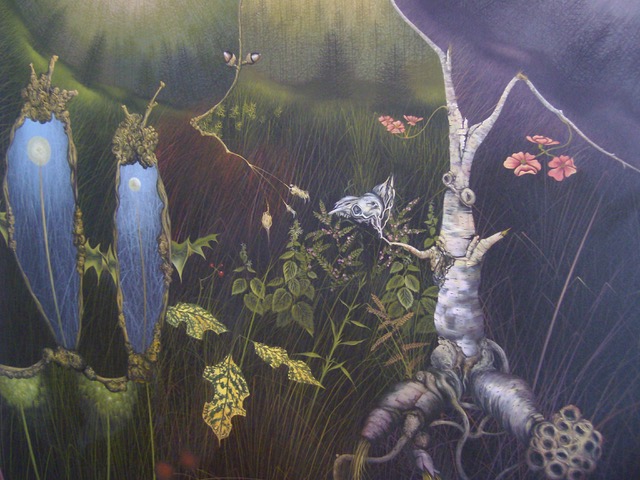
awakenings (JR oil on canvas)


When you understand that death is just a moment in life, (and I am not side-lining the human cost and heartbreaking sacrifice of the carers) Covid 19 is a reminder, perhaps at the tip of the iceberg, that we are utterly and solely responsible for challenges to the earth. Whether this clever little bug was manmade in a sterile laboratory in the name of science or profit, or is like a grinning, mutant tadpole that’s jumped from the muddy swamps of prehistory, or from neglect, filth and harm, it is no matter, and time will tell; whatever its’ origins, they belong to the same disrespect and disregard for our home. We are swimming in our own shit, above and below, and our resources are finite. It is arrogant, and too late to presume we are guardians of the planet. I would like to think that the planet is pulling us back from error, and her remit is to take some of us fukkers out.… but there are too many idiots out there with money and power just doing what they want…operating as economic predators.

As regards other world changers like the so called terrorist attack of Twin Towers in New York, it doesn’t take long for our imaginations to kick in and flourish with conspiracy theories and alternative rationales not discussed or aired by the mainstream. That we disbelieve this mainstream reporting, disbelieve the payrolled, media puppets, and commerce-dependant scientists, disbelieve the professional, governmental and institutional agendas stating ‘facts’, is our healthy paranoia and distrust of the system. ‘Democratically’ we vote these clowns in and all these agents have been proven to lie for power and effect.

Administrations were faulted at having no imagination to predict such circumstances. How ironic then that the conspiracy theorists have all the imagination after the ‘crime’. How odd then that sci-fi directors and artists and designers have thought it all before…seen it, made it and sold the popcorn.

And, as a tangent from Rock FM, my conspiracy headlines today for Covid 19…

Extinction Rebellion, as eco warriors, finally did something fierce in defence of the planet? A virus man-made in a big-pharma laboratory where a vaccine has already been made to sell to the world? A ‘boomer-buster’ genocide operation, isolating the snowflake youth, already hallucinating with interfaces and tablet games, to progress into becoming robots and slaves for world corporations? 5G (at least) mobile coverage messing with the biosphere and our heads, in much the same way as bees become diseased and disorientated, our juices mutating at a cellular level? Would you put your head in a microwave? Will we obey the Dark Lord and give him information? A radiation connection? The planet is a sentient being and knows what to do? And bats? Are we hallucinating from wheat, sugar and Mars Bars to make us insulin resistant so some malevolent off-planet ruler can take over our senses? The little blighters are hitching a lift on airborne pollution to a post-code near you? You can believe any one of these and they can all be used by that proverbial 1% of the population that would profit from the harm. Cartoon sketches indeed? All blockbuster hits for your entertainment. Your contagion, clothed in designer gear from China, soaked in sweet perspiration with a hint of Chanel, will be rattling and contaminating the gyms again soon.
World of Tat-Llanberis
 

Vaccines are not the answer. We need an empathic approach. If we need drugs to stay on this planet, we have no right to be here. Covid 20 is already being incubated in the hearts of those who put themselves before the planet.

There is mystery here too, of course, because the reality is that we don’t have a clue who we are…we only know the shit we produce. May the force be with you. And be kind…and fierce.


John Redhead. Lous Manes, Costoja, Catalunya Nord. April 2020 

All images supplied by JR.


Tuesday, 5 May 2020

Nanga Parbat Pilgrimage: Vertebrate reissue reviewed


Nanga Parbat Pilgrimage: Hermann Buhl (translation by Hugh Merrick).
448 pages; Perfect Bound Paperback: £9.99. Black/White photographs.

My thoughts, my dreams, my whole life were nothing but the mountains’ The author.

When this outstanding autobiography was first published in Germany in 1954, by an act of serendipity I was in Innsbruck the following year, the home city of Hermann Buhl and learnt from some of the locals, that he was admired by them in that era, rather like George Best or Zatopek were back in the UK. We were not used to climbers receiving that kind of recognition but once we learnt about his other ascents besides the Nanga Parbat climb we understood what the ‘gush’ was all about, and in 1956 the publication of ‘Nanga Parbat Pilgrimage’ in an English hard case bound edition made his story widely known both in Britain and the USA. A book which became an instant classic despite its grammatical short comings, for its is brim full of cliché and aphorisms, but it is also full of action and incredible achievements, and none jarring romantic observations of the wonders of the mountain environment as its subject, Buhl ascends up through them in the ongoing yearly seasons. So I am writing about a book that has inspired more than one generation of mountaineers by what Reinhold Messner; one of Buhls keenest admirers reports with its ‘total alpinism’.

Buhl was born poor in 1924, and his mother died when he was four and he spent some of his early years in an orphanage. He was a frail child and the older stronger children when he decided he was going to be a climber, declared to him that ‘They’ll never make a climber of me’. But he was not to be denied and fortunately for him two factors helped him in his quest, the situation of Innsbruck with mountains ranges surrounding its place in the Inn Valley, and there was a junior section of the Austrian Alpine Club based there. It was with the members of that organisation, some as young as himself he learned ‘the ropes’ and made friends that remained and joined him in his ever more ambitious ascents in the nearby limestone ranges already replete with challenging ascents pioneered by previous generations. In the Kalkogel, the nearest major climbing area to Innsbruck during his novitiate, the Wetterstein, the Karwendel, and further afield the Wilde Kaiser. During those early years Buhl was limited very much by lack of funds, for his father was a poorly paid working class artisan, and his friends came from equally materially limited backgrounds. But just like the working class climbers in the UK they became adept at ducking and diving, sleeping in hay ricks , unable to afford to stay in the climbing huts when visiting areas like the Wilde Kaiser, but building up their expertise and moving up through the grades of the climbs they tackled. 
 
Surprising- to me is that he managed to keep climbing through the early years of the war, but he was only 15 years old at that start of that conflict. Over those years leading up to his being called up into the Army in 1943 at 18 years, he had already achieved many major ascents with climbs such as the Schusselkar east wall in the Wetterstein, this a route with the highest grade of that era, a V1+. It was not until British climbers started repeating some of these routes that realisation was made of how imposing they really were. For instance the Lalider North Wall in the Karwendel is 3000 feet in height and was first climbed by Hias Aukenthaler and Hannes Schmidhuber in 1933. Both these two were climbers from Innsbruck, with the first earning his living as a chimney sweep. Ian Howell and myself learnt the hard way that a route like the Schmid/Krebs on that face was not to be dismissed lightly, as we had also found epic the Schmidhuber on the Kleine Ochsenwand in the Kalkogel; both of these grade V1 routes were also pioneered in the 1930’s.

When first into the Army in 1943 it seemed Buhl enjoyed a cushy posting in St Johann at the foot of the Kaisergebirge ,training in the Army Mountain Ambulance School, but being such a dedicated climber, and with a like minded fellow recruit, they bunked off and pioneered the first ascent of the Mauk West Wall. The hardest climb then in the Wilde Kaiser range, for which on returning to barracks he was court-martialled, and the result of which was of him being transferred to an infantry regiment. There follows in the book a blank climbing history of the next three years; with war, bullets flying and a prison-camp behind barbed wire. My memory from Innsbruck friends is that he took part in the Italian campaign, and was captured by the Americans, so it was the summer of 1946 before Buhl was back to climbing. And as he makes plain in his book, this was then in a country where everything was scarce, especially food, and it really sorted out the dedicated climber from the mere dabbler. I can empathise with that, for when I started climbing in the late 1940’s we faced a similar situation, maybe not as bad as the Austrians but we were supposed to be feeling victorious as the winners in the conflict? Readers might be interested that even in 1955 when I was in Austria it was still occupied, and Innsbruck was in the French zone.
Post the war, Buhl worked at odd jobs, but eventually he decided to apply to become a mountain guide. In order to even qualify for taking the tests for this, he had to spend two years as a hut porter, carrying goods from the valley to an alpine hut. Which he undertook; but he was also climbing as much as possible and eventually he qualified as a guide. Soon he was notching up major ascent after major ascent, the North Face of the Cime Ovest, the Royal Wall of the Civetta (the Solleder/Lettenbauer) , Furchetta North Wall, Marmolada South West (in winter) etc for he had managed, by initially crossing the border illegally and then later when normal relations were resumed and he had gained a passport, legally travelling to climb in the Dolomites.

In 1948 the Austrian Alpine Club received an invitation for four climbers to visit the Ecole National e in Chamonix. Hias Rebitsch, Luis Vigl , Erwin Schneider and Hermann were chosen for this. The weather was bad that year in the Mont Blanc range, but Rebitsch, Vigl and Buhl managed the North Face of the Grand Charmoz, with Heckmair’s Direct finish, and Buhl and Vigl ascended the North Face of the Triolet. After which no more climbing could be achieved for the weather was truly atrocious.

So Buhl’s life was set, climbing and guiding, and his ascents became ever more impressive, he made some outstanding winter ascents, and even more impressive solo, often achieved in inclement weather or at night. The outing for which he was most known before his Nanga Parbat climb, was his solo of the North East Face of the Piz Badile. This began with him catching a train from Innsbruck to Landeck; then he cycled the 100+ miles to Promontogmo via the Maloja Pass, and reached the Sciora hut under the Badile that evening. Next morning he started climbing at 6.00am and he gained the summit of the climb at 10.30am. Four and a half hours for a route on which previous parties had needed to bivouac, which stunned a group of well known Italian climbers who met him on the summit, but he was not finished for he then traversed this and descended the North Ridge of the Mountain, a creditable route in ascent. He then descended to Promontogmo, mounted his bike and cycled back to Innsbruck, but in fact he didn’t, for he nearly drowned in the River Inn. Arriving in Landeck he fell to sleep on his bike and ended in that fast flowing river. Fortunately he could swim and the cold douche woke him as he was about to be swept downstream. He then caught the train from Landeck back to Innsbruck. If you have climbed the Badile, driven the Maloja Pass with a 3000 ft climb back up from Promontogno to its summit, you will I am sure like me feel that this outing was something else? Actually carried out because of a lack of funds to travel otherwise, but sadly resulting in his bike being damaged beyond repair. 
 
As possibilities to travel improved and Buhl was able to do so, he notched up an impressive list of ascents; the Walker Spur of the Grandes Jorasses, the North Face of the Eiger, this latter ending in a fight for life, whilst caught in a blizzard, and with him in the lead of a rope joined together of nine climbers who had met on the climb by chance. By which time he had married, Eugenie and despite his dangerous impecunious life style they were happy, for she was also a skier and climber. Eventually they had two daughters and though never well heeled somehow they managed mainly by Hermann guiding; among the mountains of the Otztal Alps. He also was in demand for film work although on one assignment he escaped serious injury by a narrow margin, when the film crew he was with were not paying attention to his rope and he fell dozens of feet down a crevasse. It taught him to make sure post that experience that the film crews he worked with had sound belaying methods. I think from action packed to action packed climb, one of the observations I would make is he was also fortunate in the support of his rope mates; Sepp Jochler, Manfred Bachman, Luis Vigl and many others but most of all Kuno Rainer. With whom he shared many of his most outstanding ascents; the Grandes Jorasses North Wall, a new route on the Laliderer North Face, a first traverse of the whole of the Chamonix Aiguilles and much more. He seemed to complement Buhl; quiet, careful and sound of judgement, and someone who had been badly affected by his war experiences, being invalided out of the Army, due to suffering a serious stomach wound.

No mountain has more history than Nanga Parbat in the German speaking world. Although the first attempt to explore the mountains approaches was by a party led by Alfred Mummery in 1895; throughout the 1930’attempt followed attempt, and 31 climbers died during these, and it became for the Germans ‘unser berg!’ Yet Buhl’s book only takes up the last two Chapters to write about his successful climb, alone for the last 4000feet. If you read the history of the previous attempts unless you go to the mountain, and stand at the Advance Base, above the sad memorial to the deceased climbers and study the Rakhiot Face of the mountain it is hard to get a real handle on why such as Willo Welzenbach, one of the finest mountaineers of his generation could perish in such an environment. I think it has become clear in the years since Buhl’s amazing climb, why the Rakhiot route is such a challenge, because so much of the ascent is at high altitude. It is three times the length of the now ‘popular’ way of ascending the mountain, via the Kinshofer route on the Diamir face. Which makes Buhl’s ascent all the more impressive. For Nanga Parbat, 26,620ft is unlike most of the other 8000metre peaks, for it stands out alone on the rim of the Karakoram range, and the Rakhiot route faces west, open to the weather roiling up from the Indus Valley below. The other faces of the mountain are more sheltered; the Diamir and the Rupal which at 17,000ft is the largest mountain face in the world.

If you do read the history of those five German expeditions in the decade of the 1930’s, they belie the belief that the members were other than keen mountaineers driven by the mountains challenge, unfortunately some commentators believe they were politically motivated and government financed . In fact their organisers had real problems raising the necessary finance, and members often had to part underwrite the expeditions themselves. We have been in the UK so fortunate to be able to apply for expedition funding and support from the Mount Everest Foundation, but nothing like that existed in Germany in 1953 and so when an unknown figure Dr Karl Herrligkoffer appeared on the climbing scene in that country, and who was said to be the step brother of Willy Merkl who had twice gone out to Nanga Parbat, but not returned, announced he would organise a memorial expedition to the mountain, the German climbing world became infused with interest. Although Herrligkoffer had no mountaineering background, he seemed to be a master at promoting his cause in the media. Several of those who were invited to join his expedition refused; Heckmair, Rebitsch, Harrer, Schneider but Peter Aschenbrenner did agree and he was appointed to be the climbing leader on the mountain. One thing that Herrligkoffer insisted on was that all the participants had to sign a legally binding contract, which Buhl did without much thought when he was invited to take part in the expedition, something that in 1953 was not normal practice on climbing expeditions?

From the first on the mountain the climb did not precede well, and though in other areas of life and sport, German organisation is noted for its efficiency, it seems that the 1953 Nanga Parbat expedition did not meet that criteria. A group of Sherpa’s who should have participated in the climb, were not met and after much waiting for instructions travelled home again. Local porters were recruited, but some had never been high on a mountain like Nanga Parbat. The story unfolds in Buhl’s book below 26,000 feet, then above that height. Badly supported the astonishing facts are that, singularly ill-provided with food and drink, he took off on his own after all the other participants had more or less given up on reaching the mountains summit. He climbed the final 4,000ft of a Himalayan giant which had previously claimed thirty-one lives, undertaking some technically difficult climbing over completely unknown ground at an altitude normally precluding such physical effort, without the aid of oxygen. He reached the mountains summit late in the day, after seventeen hours of effort and was forced to bivouac on the descent. Returning to CampV at 22,640 after forty-one hours out in the open, he was met by Hans Ertl the camera man and Walter Frauenberger the old campaigner who had only agreed to take part if Buhl was in the team. He had done his best to organise and help with persuading the Hunza porters to carry as high on the mountain as Camp V, and was dubbed by them as ‘the kind sahib’. For the rest of this strangely administered expedition it is a sorry tale, for by the time Buhl reached Base Camp on his frost bitten feet, the climbing leaders had already left for home with most of the supplies. For a celebration dinner all that was left to eat was some noodles.

With the passage of time Buhl’s completion of the Rakhiot route on Nanga Parbat sensational when it was done, is now confirmed as one of the greatest mountaineering -feats. This expedition was the first to be headed up by Karl Herligkoffer, and in the years that followed his name became synonymous with trips that ended in some acrimony and legal argument. Buhl continued to climb and despite his frost bite injuries in 1956 he solo climbed the East Face of the Moine (Contamine route) and the Aukenthaler route on the Lalider wall. The following year he made the first ascent of Broad Peak, with a small four man party, becoming the first climber to make the first ascent of two 8000metre peaks. Soon after this momentous event Buhl died whilst attempting to make an ascent of Chogolisa. In a sudden squall a cornice collapsed and he fell and was never seen again.

His memorial, are his outstanding climbs and the memories recorded by his companions who shared his climbing life. One I wish to record is when in 1964 I met in Kathmandu’s Royal Hotel bar Erwin Schneider, and I ventured to ask him ‘What was Buhl really like’. He smiled, thought a moment and replied, ‘Beside his outstanding climbs he was a fine singer and guitar player, so he was good company!’ For me a wonderful portrait and this is confirmed in his book ‘Nanga Parbat Pilgrimage’. If you have not read this I envy you the experience, but if you did read it when it was first published in translation in 1956, I recommend you re-read it! Hugh Merrick the translator (he also translated The White Spider) I met on occasion, besides the fact that he had never then heard of the word ‘etrier’ and the march of progress in climbing was passing him by, nevertheless his translations were outstanding. I finish with thanks to Vertebrate for re-publishing this book, which despite the passing of time is still inspirational. 

Dennis Gray: 2020 
 

Sunday, 26 April 2020

Climbing Ethics: Living in the Past.


 Original High illustration: Unattributed

A casual bystander might be forgiven for not being able to differentiate between a free-climb and an artificial climb. On a hard modern route on a crag like Ravenstor you may see a climber spending several hours on the same few feet of rock, despite its fiercely overhanging nature. Certainly he will lower to the ground from time to time. He may be employing any of the modern armoury of preparation,hang-dogging, yo-yoing, pre- clipping ropes at the previous day's high points. If he is trying a new route you may well notice ropes starting from the top of the crag. We have a complex and curious code of practice which has grown up by historical accident. It is comprehensible and logical to those involved but mysterious to the uninitiated. Our system is creaking at the seams. We have a need of rules to preserve our very limited resources of rock and to keep a meaningful and enjoyable game for everybody. However, out of necessity, our rules have been bent out of immediate recognition by the leading protagonists of rock climbing. Perhaps it is time to clarify and reassess those unwritten rules.

Traditionally rock climbers started at the base of the crag and climbed upwards. This was very logical and efficient on most climbs done until about 1970. It was satisfying and adventurous but, because of the nature of most British crags and routes, was doomed. Unprotected outcrop routes on grit or sandstone always maintained a different set of rules. Top roping prior to a lead was common on sandstone and not infrequent on grit. On sandstone top-roping became an end in itself but gritstone always maintained a strong leading tradition. Grit routes only appeared in the guide after they had been led but top-rope problems which had never been led were traditionally recorded in places such as Harrisons Rocks or Helsby. The ethics on these rocks have been maintained to the present day and most people find them entirely satisfactory even now. Although it is not always overtly stated the cognoscenti are well aware that very few new routes are done on grit without some form of prior inspection, usually including trying moves on the abseil rope if the route is of substantial difficulty.

Sometimes they are top roped but this is scarcely different in my opinion to trying the moves first as gritstone climbs are rarely of sustained difficulty. The situation is far more complicated on other types of rock. Many limestone crags or volcanic crags are loose and vegetated in their pristine state and would not offer good climbing until thorough cleaning had taken place. Consequently climbers began to abseil down and clean routes prior to their lead of the first ascent. Of course while abseiling it was possible to check out runner placements and even try moves on the abseil rope and naturally enough this was what happened in many cases. This trend was started in earnest by Ed Drummond who extensively prepared his routes prior to a lead. He was able to create many fine routes while his contemporaries, who employed traditional tactics, languished in a stalemate; doing new routes on-sight was so scary at the increasing standards of the day, which were dictated by the availability of unclimbed rock, that they could only do occasional new routes. Doing new routes on sight often meant employing aid to garden a crack and many new routes around this time used a few points of aid, which could subsequently be eliminated as the climb became cleaner and better known. 

Ed Drummond demonstrating top rope technique on Nelson's Column!

Limestone was so loose in general on the sort of terrain that could be climbed at the time, that cleaning was essential. Tom Proctor was well aware of this and he prepared routes thoroughly, allowing him to reach new standards of difficulty at places like Stoney Middleton. Pete Livesey was the first to really apply limestone methods to mountain crags and he was able to do a magnificent series of first ascents. I remember when Livesey used yo-yoing tactics to do the first ascent of Fingerlicker. It was regarded as outright cheating at the time by many leading climbers. Yo-yoing was soon to become the norm for very hard climbs. More recently climbs have been developed which involve long complex series of moves and if a yo-yo to the ground was taken after each failure or fall it might take hours to work out one hard move at the end of a difficult sequence. Each time you may get a few seconds to work out the desperate move but you need to expand a great amount of energy to get to that point. Consequently climbers have begun to use hang dogging tactics which more or less involve hanging off gear, inspecting holds and moves. After the inspection the climber must lower to the ground again to do a proper ascent.

Numerous variants of the system outlined above have been employed, each climber having his own carefully guarded internal set of ethics. For instance the climber may just lower down to a hands-off rest rather than the bottom of the pitch. What constitutes a hands-off rest is the subject of fierce argument. This complex system of ethics was developed for very hard climbs when there was no other way of doing the routes within existing concepts and methods. Of course, methods employed at the top end gradually percolate down through the ranks and now we see climbers yo-yoing VS climbs. That does not affect anyone and so it does not really matter. Foreign climbers have developed their free climbing along different lines, each style appropriate to the area in which it developed. Bolts are totally accepted in places like Yosemite and Tuolumne where many climbs would be totally unprotected without them. In Tuolomne bolts are usually placed on the lead because of the relatively easy-angled nature of much of the rock. This would of course be totally impossible on a fiercely overhanging limestone climb such as Hangman in Gordale. Americans otherwise have a similar system to us in Britain. France has a different system, probably because their historical traditions were inappropriate for putting up hard climbs in places like the Verdon Gorge. Basically you can do whatever you like so long as you do one clean lead in the end. Climbs in the Verdon are often done from the top down. The top pitch of a route is top-roped first to see that it is climbable. Then protection bolts are placed on abseil and the sequence is repeated for the pitch below until a whole route is created. This system has been highly successful in creating magnificent and very hard free climbs. In a way French climbers started from scratch, rejecting traditional alpine climbing methods as inappropriate for modern climbs. Perhaps the time has come in Britain to do the same. 

Alan Rouse

On many modern climbs the climber is employing a whole array of tactics to avoid the dreaded top-roping but often in practice what he is doing is a highly inefficient way of top-roping. Maybe we should look to the French for our future climbs if we are to progress in standard. Judging by the recent solo of Revelations by a Frenchman their system turns out some brilliant climbers. (Of course their sunshine helps as well). Many modern climbs have not had leads without yo-yos or falls. It would be interesting if a truly clean ascent were to get more credit. The basic idea of free rock climbing is to climb a piece of rock without any physical assistance from the rope. The rope and protection should only be for assurance — as it is they are often extensively employed even in the final ascent. Apart from tactics employed the other issue which needs some thought is that of bolts for protection. Bolts have arrived because the remaining unclimbed rock is otherwise unprotectable. It is fair enough to have the occasional death route but if, for example, bolts had been prohibited at Malham then nearly all the recent new routes would be death routes and no one would want to do them. Yet it is very obvious that people get great pleasure from bolt-protected routes. Bolts are here to stay in British climbing.

Few people would advocate placing bolts on routes traditionally done without them but for the future it is now clear that bolts will play a major role in creating fine new routes of the highest standards. In the past the development of more and more sophisticated nuts and then the advent of Friends kept pace with the climbs that people wished to do at the time. This is no longer true. Everyone has private reservations about just where bolts should be placed. Most people agree that Stanage, for instance, should remain free of bolts but most people who climb very hard routes are perfectly happy with bolts on limestone and North Wales slate. They have not been fully accepted anywhere in the sense that most placing of bolts is still the subject of debate. Some climbers feel that the bolts should. be placed at respectably large intervals so as to simulate the traditional excitement and danger of British free-climbing. This has an intrinsic problem in that you will often end up with only one bolt of dubious holding power between you and the ground. With repeated falls this bolt will eventually fail and a serious accident will ensue. If you are going to place bolts you may as well make the route reasonably safe rather than contrive an artificial danger level based on the quality of the metal in the bolt and the solidity of the rock in which it is placed. 

If, as is often the case, the first ascensionist has done extensive preparation of the route then he is in a position to climb the route with very limited protection if he chooses to do so, but where does that leave the next climber who wishes to do a repeat ascent? Prior knowledge may be essential if hidden holds and hidden runner placements are involved. It has become a dodgy business going to repeat a new route in Derbyshire unless you have the inside information. It seems better to create a route which subsequent climbers can do from the ground upwards. It is highly inconvenient if a prior abseil inspection is necessary to do a subsequent ascent. A climber cannot add bolts or pegs to a climb done without them, therefore, the first ascensionist has a responsibility to future climbers. He should seriously consider the problems that will face a climber who is not armed with the knowledge which he learned from the prior inspection. 

Alan Rouse: 1985.

First published in High-November 1985.
 

Monday, 23 March 2020

Hard Rock 2020.....Reviewed


Hard Rock. Great British Rock Climbs from VS to E4, compiled by Ian Parnell, made up of 288 pages with colour illustrations throughout. Case Bound, Hardback with Jacket. £39.95.

It’s an old Ken Wilson maxim; a picture is worth a thousand words, so snap away, snap away!’ From a song by the author.

This is the fourth edition of one of the most influential climbing books of the 20th century. The first edition appeared in 1975, and a third in 1992; their compilation being by the late Ken Wilson. This new edition compiled by Ian Parnell is now appearing in a changed world, heralded in a new century with digital publishing and communication, and a sea change within the sport of rock climbing, impacted by equipment innovation, the spread in the UK of over 400 indoor climbing walls, and the increasing popularity of Sports Climbing and Bouldering; some might suggest to the detriment of Trad. Hopefully this new re-vamped edition of Hard Rock will capture the imagination of the many newcomers emerging into our sport, mainly now from indoor climbing to embrace all that is adventurous, and challenging about traditional British rock climbing. Set in some of the most beautiful landscapes to be found anywhere.

When a large format Hard Rock book appeared in 1975 its inception by Ken Wilson is now misreported by some of the pundits. Its origins began on the Continent, when in 1970 Walter Pause’s book ‘Im Extremen Fels-100 Classical Extreme Climbing Routes’ first appeared. This was an immediate publishing success, and a staffer who was something of a climber at the London publisher, Hart Davis-MacGribbon noted this and phoned Ken Wilson, who was by that date editing Mountain magazine for his views about producing such a volume of outstanding British climbs. Ken who was always a man with strong opinions, retorted it would need to be different here in the UK; a book with essay type descriptions, literary with good photographic cover, highlighting our tradition of bold and self protected rock climbs, keeping the route, not the climber centre stage. His interlocutor was impressed and Hart Davis-MacGribbon commissioned Ken to compile such a book. In passing, also in 1975 there appeared in France, ‘The 100 best climbs in the Mont Blanc Massif’ compiled by Gaston Rebuffat, which was another ground breaking publication and instant success. But both this and Pause’s book were more of a guidebook style than Wilson’s ‘Hard Rock’.

Life is a succession of accidents, if that ‘phone call had not occurred then Ken’s later publications of ‘Classic Rock’ ‘Extreme Rock’ ‘Cold Climbs’ all in the same format as ‘Hard Rock’ might never have appeared. And if he had not been editing ‘Mountain’ magazine he possibly would hardly have been known to a staffer in a London publishing house. Not enough credit has been heaped on the historical development of this by recent commentators, for ‘Mountain’ magazine would never have come into existence without its predecessor ‘Mountaincraft’, the house magazine of the Mountaineering Association formed in 1947 by another controversialist Jerry Wright. Many climbers of the 1950’s cut their teeth on ‘MA’ courses in the UK, and the Alps and Ken and a school friend, his early climbing partner Dave Cook learnt their Alpine craft on an ‘MA’ course in Arolla. Allan Austin learnt to climb in the 1950’s on a beginners ‘MA’ course in Llanberis instructed by Robin Collomb. But the Mountaineering Association was kept functioning by Jerry Wright, and at his demise it began to unravel. 

The editor of ‘Mountaincraft’ was a Guardian journalist, Roger Redfern, someone I knew from having written articles for him, and he was far seeing, realising that with the winding up of the ‘MA’ a buyer had to be found for the magazine. How he settled on Ken is another story, but to Wilson’s credit he gave up a secure job in architectural photography in 1968 and took this on, eventually changing its title to Mountain which he edited from 1969 to 1978.

Those who were never privileged to know Ken Wilson, who died in 2016, missed meeting perhaps one of the most controversial and influential figures of the British mountaineering scene in the last half century. His brusque approach did not always win him friends, but as a climbing publisher he was pre-eminent and his final effort, a total re-vamp of ‘Classic Rock’ published shortly before his death was his 60th publication! There are so many stories surrounding him that I will only give a single illustration of how his character impacted on his fellow climbers. In 1972 he applied to be a member of the Alpine Club, an application which generated a previously unequalled wealth of correspondence. A group of members threatened to resign if he were ever to be elected, but those were offset by those who threatened to resign if he were NOT elected. Happily he was elected and his scene setting, original historic introduction in the new edition of ‘Hard Rock’ is included in full and gives some measure of the man.


Created from Ken Wilson's original photo of John Beck climbing the now departed upper section of Deer Bield Crag.
This new edition is truly impactful photographically with colour included throughout, but I would have kept a few of the original black/white prints, for instance Leo Dickinson’s picture of Gogarth’s ‘Dream of White Horses’ would have been a must to include for me; as it was for Wilson who on one occasion in a considered judgement awarded this as ‘One of the ten best of all climbing pictures!’ Black/White is sometimes more atmospheric, more moody and sharp edged than colour. The original ‘Hard Rock’ included sixty climb essays, this new edition has sixty-three, but some of the originals have been dropped, including Kilnsey Overhang and The Scoop of Strone Ulladale, the first by Dave Nicol the second by Doug Scott. But their essays appear at the end of the book, as an addendum removed by the fact they are now climbs outside the grades of this volume, existing today as high standard free climbs. Two other originals which have also been axed, really hurt for one is the North Crag Eliminate of Castle Rock, pioneered in 1952 by Harold Drasdo and myself (I was 16 years old at that date), and Deer Bield Buttress, Arthur Dolphins masterful 1951 climb, the essay for which was also by Harold, one of the best in the original book, for both routes have now subsequently fallen down! 
 
The original essays were by some of the then best known personalities of the British climbing world; Hamish MacInnes, Pete Crew, Chris Bonington, Ed Ward Drummond, Al Alvarez, Ian McNaught-Davis, Jim Perrin, Allan Austin etc but it was the lesser known in 1974 who for me wrote some of the most memorable ones, e.g. Dave Cook on the North West Girdle at Almscliff and Robin Campbell writing about Swastika on the Etive Slabs. Other stand out originals were Royal Robbins on ‘A Dream of White Horses’ and Jimmy Marshall on Carnivore, the first because it is about an ascent Royal made of the climb partnered by Ken Wilson, and he so captured his character in his writing, wittily but kindly and the second because it was such a breakthrough Scottish climb in which he wrote of how Pat Walsh presented him with his piton hammer, left hanging by Jimmy off a retreat peg, after he had made a second ascent attempt on the route; for I was the one who partnered Pat on the occasion when we had actually succeeded. 

I hasten to add that Jimmy soon returned and he too sent the route. And in passing (once more), in the late 1950’s Walsh was amongst the most outstanding rock climbers in the UK. One of the ‘great’ climbs in Hard Rock is Shibboleth, Robin Smith’s route on the Slime Wall of the Buachaille Etive Mor. Pat had opened up that feature long before Robin, and he felt you could climb it almost anywhere! At a desperate standard; Joe ‘Morty’ Smith and I experienced real difficulties whilst attempting to repeat his climbs for so vague were his verbal descriptions. 
 
The routes included in this new edition stretch across the Scottish Highlands and Islands (including the Old Man of Hoy and Pabbay), the Lake District, The Pennines, The Peak, North and South Wales, and down to South West England; and the climbs chosen include Mountain Walls, Gritstone Outcrops and some epic sea cliff adventures. It includes thirteen routes and essays by nine new authors (which were not in the original), some at a higher grade than the earlier editions which were aimed at the trad connoisseurs range of VS to E2. I think these would be within the capabilities of a majority of climbers, but E3 or E4 has to be a maybe? Unless there has been a vast grade swing upward in the last decade? Of the new authors a couple really did grab me, Dave Pickford writing about Swanage and two climbs at the Boulder Ruckle, one by an old mate Richard Crewe; Mars. I had the ‘grip’ of pioneering a new route with Richard at that cliff, and our equipment included peg hammers with curved picks to climb out up the last section of loose ground to the finish, and Kevin Howett writing about the Vulcan Wall on Skye. Originally pioneered by another old mate Ian Clough and Hamish MacInnes, the latter I first met on the Cobbler in 1951 as a 15 year old. 
The Author soloing on the Pembroke cliffs
For me the whole book is a climb down memory lane, so many friends from the original have now departed the scene and re-reading about their great climbs, Whillans on Extol, Pete Biven on Moonraker, Dolphin on Kipling Groove, Tony Barley on Carnage, and Nat Allen writing about Peak classics like the Chee Tor Girdle etc (I lived at Nat’s mothers house in Derby for three and a half years) brought them back in their pomp for me. One figure resplendent, who still remains with us, is the Baron; Joe Brown. I speak to him regularly by ‘phone, but I can guess anyone reading ‘Hard Rock’ and coming new into the sport as a newcomer must think on reading ‘Hard Rock’ how could one climber pioneer so many of the most outstanding rock climbs in this country? The 1950’s were his decade, and the 1960’s almost the same, in no other sport do I know where one participant has been such an influence for such a long period. We both agree that to be active in those decades was indeed a happy accident of birth. 
 
Being a pedant I feel I need to provide some further information for Frank Cannings who wrote the essay about Suicide Wall/Bow Wall on Bosigran in Cornwall. He was correct that on the first ascent on the crux pitch of the first route, Peter Biven, stood on Trevor Peck’s head and placed a peg for aid to gain a pair of cracks leading up to the next stance. He also mentions in his article that The Rock and Ice Club visited Cornwall in 1957. On that visit Joe Brown and I, were guided on occasion by Biven and Peck and we all four made the third ascent of Suicide Wall. Joe led the route including the crux free, and Peter and Trevor joined our rope, not wishing to try to emulate Brown’s free lead of the crux. So Brown led the first free ascent of the Suicide Wall. Readers may be interested to know that I had been to Cornwall in 1956, and met on that occasion a very ancient A.W. Andrews who is acknowledged as the original pioneer of sea cliff climbing in this country, and my waywardness in spending my precious holiday time climbing in an area such as West Penwith was met with scorn by Don Whillans. ‘You should save climbing in such areas until your old and past it!’ he advised when we agreed to go to Cornwall in 1957; Don was heading for Masherbrum! 

I noted in Cannings article that he seemed surprised that we did not achieve more on our visit, but in those days we all worked and enjoyed restricted holidays. So a week in Cornwall was as much as most could manage. Joe by then had his own, one man property repairing business, so he could afford to stay on after we left, and he pioneered the first section of Bow Wall but could not find anyone to second him up the rest of that route. 


Leo Dickinson's classic shot of Ed Drummond and Dave Pearce on the first ascent of A dream of White Horses
So all in all, this ‘Hard Rock’ is a worthy successor to all that has gone before. I can imagine Ken Wilson looking at this from on high and doubtless he would have something to add on incorporating some ideas into the new edition of the book. It is fitting that Ian Parnell has been the one to take this on; for I would guess that in Ken’s eyes he would be a ‘real’ climber, with many different disciplines under his belt; of bold and badly protected leads on British cliffs, a pioneer of Scottish winter routes, an ascent of the North Face of the Eiger, and outstanding success in the Himalaya etc. Wilson would have revelled in that? Finally the books, layout and quality, is what we have come to expect of Vertebrate. The line drawing end papers by Malc Baxter add to the whole excellent appearance of the work. But as a tight wad I am wondering if the price of £39.95 is one that will put it out of reach of most of the young and or the impecunious? However maybe a case might be made that in view of the dreaded coronavirus; a grant to purchase might be forthcoming from the DHSS to help any such activist while away their boredom whilst in self imposed isolation? 

Dennis Gray: 2020 
 

Tuesday, 17 March 2020

Snowscape


El Capitan-Original Photo- Mike Murphy

An Open Letter From Ed Drummond

The following relates to an attempt in October, 1984 by Ed Drummond to solo El Capitans's North America Wall, and his rescue,after days in a snowstorm, a pitch short of easy ground below the summit. Two other climbers died on the nearby route-Zodiac-in the same storm.


Epilogue: To Search and Rescue Officers Mike Murray, John Dill and all SAR Personnel, National Park Service, Yosemite, California. 

Dear John, Officer Murray and all SAR people...

It's now almost a month since — in a very I real sense — you all brought me back to life. The operation was difficult. After two weeks alone on the North American Wall, I had become a possibly terminal patient in the grip of a condition so overwhelming, as to render it almost impossible for a team to even get near me, let alone operate: ice on the brow of the captain, the sudden relapse of snow that forced even the most skilful and experienced climbers to inch their way for hours tied together, where in summer they could amble with their hands in their pockets. The first October snow in 20 years. It was like trying to get blood from a stone. And I was a long way down. Too far I had begun to think, sunken beneath great overhangs like some pitiful heretic, shivering, beginning to repent. I started to call out, almost embarrassed to be raising my voice: to a  gap in the cloud, to a toy-red and white helicopter spiralling past, wondering if they a could lip-read but worried that they might think I was simply hailing them good-day and a not drowning in the bathtub that my porterledge had become. And to the drab valley floor with its sudden lichen of onlookers.  I — and to the cloudy void where the wind was lurching like a drunk smashing bottle after bottle of distilled water at the wall and tearing a at my fly until that hymen of self-assurance, intact these forty years, had started to come apart... I, I,.... well I, at first shyly, then shamefully — suddenly — savagely — desperately — miraculously — screamed.. "Help! . . . Help!"

I had heard that there were two others in trouble on the Zodiac. And some haunted, hurt part of me knew, just knew, they'd go for double, rather than one on the NA. I in became my own dentist: 'get what I deserve',poking in childhood cavities I'd forgotten I had, living in California these past eight years after chilly Britain. Then I'd start grabbing the drill and imagine I heard voices right next to to my head, like the couple next door . . . to Nothing. 

I'd listen again . . . Just footsteps in my a chest. The pipes kept running. Does hearing go first?  An hour. Two. Three. The web of suspension straps inside the hanging tent had become chains of ice-water. My sleeping bag, like a shrunken mummy in some flooded museum, was oozing through my hands. I had eaten all my food. Is insolite edible? I imagined not, and given the rate of loss of my core heat, even the vomit would be cold. I envisaged the headlines in the National  Enquirer: "Man Saves Life by Eating Bed". And the tawdry photograph of me with the ectoplasmic taco, grinning . . . But the bizarre  scenario helped me stay awake for a minute and generate the idea of padding my back with  insolite. Then a roll inside each trouser leg.  Pretty soon I looked like some punk Galbraith  with my hang dog face and bean pole limbs. Intellectually and emotionally I was a scarecrow — flash of a young man in Reagan country, sleeping beneath the freeway in San  Francisco last winter, with a sheet of cardboard over him. Why do I do this?

Something fluttered in my trousers. Greasy, slow bubbles down my thigh, not at all my usual colourful fart. And cold too. Now that alarmed me .. . Suddenly sleepy I tried to curl up — like when the bullies, Ormerod, Evans or Jeremy Bentley would corner me. I felt nine years old, just lying there in the freezing water, like I used to in the bath at home a long time ago. And wait and wait and wait for my mother to come and get me out and pat me, and dry me and warm me .. . Deep, soft, sweet, Death was brushing my hair, running its reptilian fingers across my  damp forehead, whispering in my grubby ears: "Relax, relax. Try to sleep." "He's here." Out of my mind, out of the flapping tent, hanging like a lynching as he swayed to fro, there he was: the other, thou, my not-me, the god-man with a radio, out in space at the end of a white and blue line, swimming in towards me, with the new moon on his shoulder. "How are you?" 

Words stick in my throat. John: young, shy, quietly competent as a carpenter straddling the roof beams as he comes in, hand over hand down my tied-in haul line and plugs me back in. I touch him. "Can you jumar?" "What about all your gear?" The rest is history and this story. How you all came back to me, one by one. Walt — Cagney-tough at the last edge, snapping pits and talking down the great north american wall that hung under us; Werner: silent, reassuring, with a wink in his eye as I dredged myself upwards. And then, now, there, here, all of you: grinning, grubby as pirates, efficient as pilots, snow sticking to your ears and beards, eyes shining: Gary, Des, Mike, Livia handing me her head torch — the clan, the tribe, my family I never really believed in or knew I belonged to — reaching for me, clipping me in, guiding, slapping me quietly on the back "Too bad, so close" — my eyes tighten, glowing, liquid, making their faces wavery, dream-like as they peer in, pushing, pulling me across dark, slick slabs and shepherding me past the boney rope in its integument of ice, through bottomless brush, feet dying a bit now in tight Fires, eddying upwards on faint trodden tracks through the fourteen inches that had clubbed the Sierras, to Paradise: huge, orange tongues, crackling logs, melting the snow, illuminating the big tents, licking the night. 
 Ed- Image John Cleare.

And two witches, with warm clothes, tending the fire, ladling from an ancient cauldron, dripping spaghetti over sourdough bread, passing dry socks, hot coffee and, unbelievably, when only the embers were glowing, large, flashy, red apples, under the stars, scattered like implacable dice. No matter — who can say whether for or against us? —I was home. Without all of you — from those in the office who made vital calls and kept the lines open; the drivers, the pilots, Jim and the camp people, those two women who'd downed tools from trail repair to go up in the snow and keep house in the night for total strangers, the climbers themselves; the anchor men, those at the edge, and John — you who all came in like surgeons, parting the dark blue void and the webs of red and blue knotted together, searching beneath the polypropylene clothing, inside the sodden sleeping bag and the funny reputation, for that unique, red flower, each carries from the cradle to the edge of cliff, fading and fountaining every second —without everyone of you, I would be dead. Thank you from the bottom of my heart. Edwin Drummond 

Ed Drummond: January-1985

First published in High