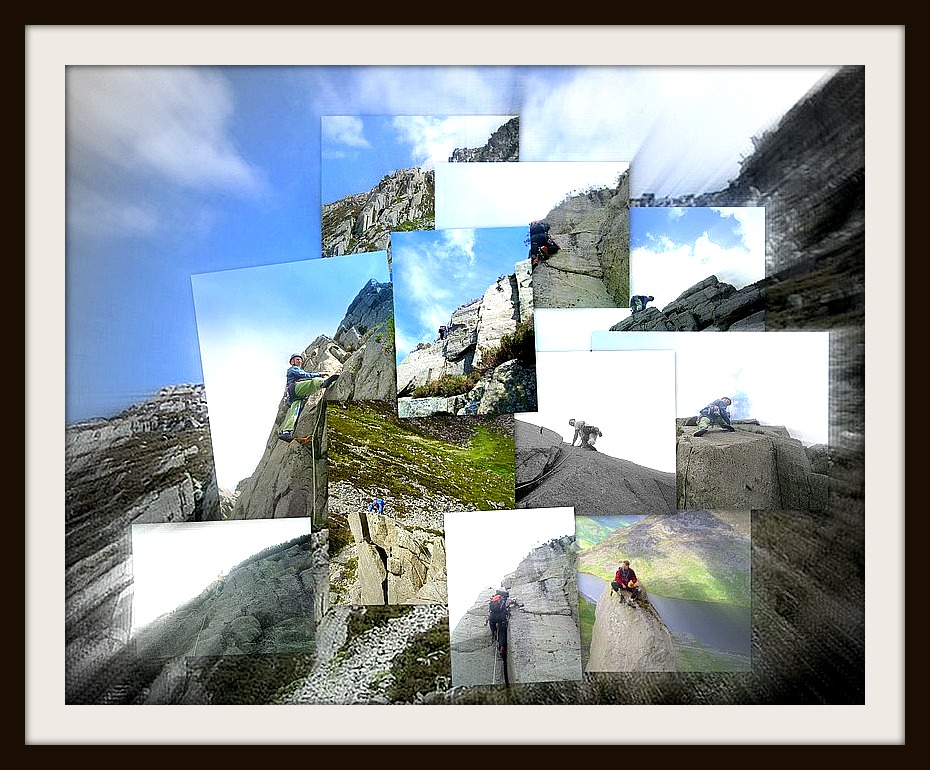
Thursday, 15 September 2011

The Rescue

At eventide, upon a dreary sea, I watched a mountain rear its hoary head To look with steady gaze in the near heaven. The earth was cold and still. No sound was heard But the dream-voices of the sleeping sea. The mountain drew its gray cloud-mantle close, Like a Roman senator, erect and old, Raising aloft an earnest brow.


 "The sunset," he cried; "we must have the whole horizon." Then he started running along the ledge like a mountain goat, working to get around the vertical cliff above us to find an ascent on the other side. He was soon out of sight, although I followed as fast as I could. I heard him shout something, but could not make out his words. I know now he was warning me of a dangerous place. Then I came to a sharp-cut fissure which lay across my path—a gash in the rock, as if one of the Cyclops had struck it with his axe. It sloped very steeply for some twelve feet below, opening on the face of the precipice above the glacier, and was filled to within about four feet of the surface with flat, slaty gravel.

It was only four or five feet across, and I could easily have leaped it had I not been so tired. But a rock the size of my head projected from the slippery stream of gravel. In my haste to overtake Muir I did not stop to make sure this stone was part of the cliff, but stepped with springing force upon it to cross the fissure. Instantly the stone melted away beneath my feet, and I shot with it down towards the precipice. With my peril sharp upon me I cried out as I whirled on my face, and struck out both hands to grasp the rock on either side. Falling forward hard, my hands struck the walls of the chasm, my arms were twisted behind me, and instantly both shoulders were dislocated. With my paralyzed arms flopping helplessly above my head, I slid swiftly down the narrow chasm. Instinctively I flattened down on the sliding gravel, digging my chin and toes into it to check my descent; but not until my feet hung out over the edge of the cliff did I feel that I had stopped.

Even then I dared not breathe or stir, so precarious was my hold on that treacherous shale. Every moment I seemed to be slipping inch by inch to the point when all would give way and I would go whirling down to the glacier. After the first wild moment of panic when I felt myself falling, I do not remember any sense of fear. But I know what it is to have a thousand thoughts flash through the brain in a single instant—an anguished thought of my young wife at Wrangell, with her imminent motherhood; an indignant thought of the insurance companies that refused me policies on my life; a thought of wonder as to what would become of my poor flocks of Indians among the islands; recollections of events far and near in time, important and trivial; but each thought printed upon my memory by the instantaneous photography of deadly peril.
I had no hope of escape at all. The gravel was rattling past me and piling up against my head. The jar of a little rock, and all would be over. The situation was too desperate for actual fear. Dull wonder as to how long I would be in the air, and the hope that death would be instant— that was all. Then came the wish that Muir would come before I fell, and take a message to my wife. Suddenly I heard his voice right above me. "My God!" he cried. Then he added, " Grab that rock, man, just by your right hand." I gurgled from my throat, not daring to inflate my lungs, " My arms are out." There was a pause. Then his voice rang again, cheery, confident, unexcited, "Hold fast; I'm going to get you out of this. I can't get to you on this side; the rock is sheer. I'll have to leave you now and cross the rift high up and come down to you on the other side by which we came. Keep cool." Then I heard him going away, whistling " The Blue Bells of Scotland," singing snatches of Scotch songs, calling to me, his voice now receding, as the rocks intervened, then sounding louder as he came out on the face of the cliff. But in me hope surged at full tide.

I entertained no more thoughts of last messages. I did not see how he could possibly do it, but he was John Muir, and I had seen his wonderful rock-work. So I determined not to fall and made myself as flat and heavy as possible, not daring to twitch a muscle or wink an eyelid, for I still felt myself slipping, slipping down the greasy slate. And now a new peril threatened. A chill ran through me of cold and nervousness, and I slid an inch. I suppressed the growing shivers with all my will. I would keep perfectly quiet till Muir came back. The sickening pain in my shoulders increased till it was torture, and I could not ease it. It seemed like hours, but it was really only about ten minutes before he got back to me. By that time I hung so far over the edge of the precipice that it seemed impossible that I could last another second. Now I heard Muir's voice, low and steady, close to me, and it seemed a little below. " Hold steady," he said. " I'll have to swing you out over the cliff." Then I felt a careful hand on my back, fumbling with the waistband of my pants, my vest and shirt, gathering all in a firm grip. I could see only with one eye and that looked upon but a foot or two of gravel on the other side. "Now!" he said, and I slid out of the cleft with a rattling shower of stones and gravel. My head swung down, my impotent arms dangling, and I stared straight at the glacier, a thousand feet below. Then my feet came against the cliff. " Work downwards with your feet." I obeyed. He drew me close to him by crooking his arm and as my head came up past his level he caught me by my collar with his teeth!


My feet struck the little two-inch shelf on which he was standing, and I could see Muir, flattened against the face of the rock and facing it, his right hand stretched up and clasping a little spur, his left holding me with an iron grip, his head bent sideways, as my weight drew it. I felt as alert and cool as he. " I've got to let go of you," he hissed through his clenched teeth. " I need both hands here. Climb upward with your feet." How he did it, I know not. The miracle grows as I ponder it. The wall was almost perpendicular and smooth. My weight on his jaws dragged him outwards. And yet, holding me by his teeth as a panther her cub and clinging like a squirrel to a tree, he climbed with me straight up ten or twelve feet, with only the help of my iron-shod feet scrambling on the rock.

It was utterly impossible, yet he did it! When he landed me on the little shelf along which we had come, my nerve gave way and I trembled all over. I sank down exhausted, Muir only less tired, but supporting me. The sun had set; the air was icy cold and we had no coats. We would soon chill through. Muir's task of rescue had only begun and no time was to be lost. In a minute he was up again, examining my shoulders. The right one had an upward dislocation, the ball of the humerus resting on the process of the scapula, the rim of the cup. I told him how, and he soon snapped the bone into its socket. But the left was a harder proposition. The luxation was downward and forward, and the strong, nervous reaction of the muscles had pulled the head of the bone deep into my armpit. There was no room to work on that narrow ledge. All that could be done was to make a rude sling with one of my suspenders and our handkerchiefs, so as to both support the elbow and keep the arm from swinging.

Then came the task to get down that terrible wall to the glacier, by the only practicable way down the mountain that Muir, after a careful search, could find. Again I am at loss to know how he accomplished it. For an unencumbered man to descend it in the deepening dusk was a most difficult task; but to get a tottery, nerve-shaken, pain-wracked cripple down was a feat of positive wonder. My right arm, though in place, was almost helpless. I could only move my forearm; the muscles of the upper part simply refusing to obey my will. Muir would let himself down to a lower shelf, brace himself, and I would get my right hand against him, crawl my fingers over his shoulder until the arm hung infront of him, and falling against him, would be eased down to his standing ground. Sometimes he would pack me a short distance on his back. Again, taking me by the wrist, he would swing me down to a lower shelf, before descending himself. My right shoulder came out three times that night, and had to be reset. It was dark when we reached the base; there was no moon and it was very cold. The glacier provided an operating table, and I lay on the ice for an hour while Muir, having slit the sleeve of my shirt to the collar, tugged and twisted at my left arm in a vain attempt to set it. But the ball was too deep in its false socket, and all his pulling only bruised and made it swell. So he had to do up the arm again, and tie it tight to my body. It must have been near mid-night when we left the foot of the cliff and started down the mountain.

We had ten hard miles to go, and no supper, for the hardtack had disappeared ere we were half-way up the mountain. Muir dared not take me across the glacier in the dark; I was too weak to jump the crevasses. So we skirted it and came, after a mile, to the head of a great slide of gravel, the fine moraine matter of the receding glacier. Muir sat down on the gravel; I sat against him with my feet on either side and my arm over his shoulder. Then he began to hitch and kick, and presently we were sliding at great speed in a cloud of dust. A full half-mile we flew, and were almost buried when we reached the bottom of the slide. It was the easiest part of our trip. Now we found ourselves in the canyon, down which tumbled the glacial stream, and far beneath the ridge along which we had ascended. The sides of the canyon were sheer cliffs. " We'll try it," said Muir. " Sometimes these canyons are passable." But the way grew rougher as we descended. The rapids became falls and we often had to retrace our steps to find a way around them. After we reached the timber-line, some four miles from the summit, the going was still harder, for we had a thicket of alders and willows to fight. Here Muir offered to make a fire and leave me while he went forward for assistance, but I refused. " No," I said, " I'm going to make it to the boat."


All that night this man of steel and lightning worked, never resting a minute, doing the work of three men, helping me along the slopes, easing me down the rocks, pulling me up cliffs, dashing water on me when I grew faint with the pain; and always cheery, full of talk and anecdote, cracking jokes with me, infusing me with his own indomitable spirit. He was eyes, hands, feet, and heart to me—my caretaker, in whom I trusted absolutely. My eyes brim with tears even now when I think of his utter self-abandon as he ministered to my infirmities. About four o'clock in the morning we came to a fall that we could not compass, sheer a hundred feet or more. So we had to attack the steep walls of the canyon. After a hard struggle we were on the mountain ridges again, traversing the flower pastures, creeping through openings in the brush, scrambling over the dwarf fir, then down through the fallen timber. It was half-past seven o'clock when we descended the last slope and found the path to Glenora. Here we met a straggling party of whites and Indians just starting out to search the mountain for us. As I was coming wearily up the teetering gang-plank, feeling as if I couldn't keep up another minute, Dr. Kendall stepped upon its end, barring my passage, bent his bushy white brows upon me from his six feet of height, and began to scold:


" See here, young man; give an account of yourself. Do you know you've kept us waiting " Just then Captain Lane jumped forward to help me, digging the old Doctor of Divinity with his elbow in the stomach and nearly knocking him off the boat. "Oh, hell!" he roared. "Can't you see the man's hurt?" Mrs. Kendall was a very tall, thin, severe-looking old lady, with face lined with grief by the loss of her children. She never smiled. She had not gone to bed at all that night, but walked the deck and would not let her husband or the others sleep. Soon after daylight she began to lash the men with the whip of her tongue for their " cowardice and inhumanity " in not starting at once to search for me. " Mr. Young is undoubtedly lying mangled at the foot of a cliff, or else one of those terrible bears has wounded him; and you are lolling around here instead of starting to his rescue.

For shame! " When they objected that they did not know where we had gone, she snapped: " Go everywhere until you find him." Her fierce energy started the men we met. When I came on board she at once took charge and issued her orders, which everybody jumped to obey. She had blankets spread on the floor of the cabin and laid me on them. She obtained some whisky from the captain, some water, porridge and coffee from the steward. She was sitting on the floor with my head in her lap, feeding me coffee with a spoon, when Dr. Kendall came in and began on me again: " Suppose you had fallen down that precipice, what would your poor wife have done? What would have become of your Indians and your new church?" Then Mrs. Kendall turned and thrust her spoon like a sword at him. " Henry Kendall," she blazed, " shut right up and leave this room. Have you no sense? Go instantly, I say! " And the good Doctor went. My recollections of that day are not very clear. The shoulder was in a bad condition—swollen, bruised, very painful. I.had to be strengthened with food and rest, and Muir called from his sleep of exhaustion, so that with four other men he could pull and twist that poor arm of mine for an hour. They got it into its socket, but scarcely had Muir got to sleep again before the strong, nervous twitching of the shoulder dislocated it a second time and seemingly placed it in a worse condition than before.


Captain Lane was now summoned, and with Muir to direct, they worked for two or three hours. Whisky was poured down my throat to relax my stubborn, pain-convulsed muscles. Then they went at it with two men pulling at the towel knotted about my wrist, two others pulling against them, foot braced to foot, Muir manipulating my shoulder with his sinewy hands, and the stocky Captain, strong and compact as a bear, with his heel against the yarn ball in my armpit, takes me by the elbow and says, " I'll set it or pull the arm off!"
Well, he almost does the latter. I am conscious of a frightful strain, a spasm of anguish in my side as his heel slips from the ball and kicks in two of my ribs, a snap as the head of the bone slips into the cup—then kindly oblivion. I was awakened about five o'clock in the afternoon by the return of the whole party from an excursion to the Great Glacier at the Boundary Line. Muir, fresh and enthusiastic as ever, had been the pilot across the moraine and upon the great ice mountain; and I, wrapped like a mummy in linen strips, was able to join in his laughter as he told of the big D.D.'s heroics, when, in the middle of an acre of alder brush, he asked indignantly, in response to the hurry-up calls: "Do you think I'm going to leave my wife in this forest?"

One overpowering regret — one only—abides in my heart as I think back upon that golden day with John Muir. He could, and did, go back to Glenora on the return trip of the Cassiar, ascend the mountain again, see the sunset from its top, make charming sketches, stayed all night to see the sunrise, filling his cup of joy so full that he could pour out entrancing descriptions for days. While I—well, with entreating arms about one's neck and pleading, tearful eyes looking into one's own, what could one do but promise to climb no more? But my lifelong lamentation over a treasure forever lost, is this: " I never saw the sunset from that peak."

From 'Alaska days with John Muir' -Samuel Hall Young.Published Fleming H Revell-1915

Wednesday, 14 September 2011

This Week: John Muir....on the edge of the abyss

John Muir-hard core all action hero in his heyday!

"Falling forward hard, my hands struck the walls of the chasm, my arms were twisted behind me, and instantly both shoulders were dislocated. With my paralyzed arms flopping helplessly above my head, I slid swiftly down the narrow chasm. Instinctively I flattened down on the sliding gravel, digging my chin and toes into it to check my descent; but not until my feet hung out over the edge of the cliff did I feel that I had stopped. Even then I dared not breathe or stir, so precarious was my hold on that treacherous shale. Every moment I seemed to be slipping inch by inch to the point when all would give way and I would go whirling down to the glacier.
After the first wild moment of panic when I felt myself falling, I do not remember any sense of fear. But I know what it is to have a thousand thoughts flash through the brain in a single instant—an anguished thought of my young wife at Wrangell, with her imminent motherhood; an indignant thought of the insurance companies that refused me policies on my life; a thought of wonder as to what would become of my poor flocks of Indians among the islands; recollections of events far and near in time, important and trivial; but each thought printed upon my memory by the instantaneous photography of deadly peril. I had no hope of escape at all. The gravel was rattling past me and piling up against my head. The jar of a little rock, and all would be over. The situation was too desperate for actual fear. Dull wonder as to how long I would be in the air, and the hope that death would be instant— that was all.

Then came the wish that Muir would come before I fell, and take a message to my wife. Suddenly I heard his voice right above me. "My God!" he cried. Then he added, " Grab that rock, man, just by your right hand." I gurgled from my throat, not daring to inflate my lungs, " My arms are out." There was a pause. Then his voice rang again, cheery, confident, unexcited, "Hold fast; I'm going to get you out of this.'

This week...tales of mountaineering heroics from the father of conservation and environmentalism-John Muir. From almost a century ago,Samuel Young recounts being totally incapacitated in a serious mountain fall and the dramatic single handed rescue conducted by John Muir.

Thursday, 8 September 2011

Claud Deane Frankland...the hunter home from the hill.

The Accident

On the late afternoon of Sunday, 31st of July, 1927, a party of four were preparing to climb 'Chantry Buttress' on the Napes. The route was considered relatively easy; graded very difficult and was certainly not a passage to over-tax their capabilities. The party was a strong one, led by Claud Deane Frankland, reputed at that time to be one of the leading climbers in the country. The other members were Mabel Barker, A. Wood-Johnson and Lawson Cook. They had been on the Napes most of the day. Frankland and Mabel Barker had climbed 'Eagles Corner' and they found an egg in 'Eagles Nest' — an interesting incident overshadowed by the tragic happening later that day.
They decided to rope up in two teams with Frankland leading the first rope. He climbed the first pitch and brought up A. Wood-Johnson, who was his second. Frankland was commenting about their successful traverse of the Cuillin Ridge a year earlier — these remarks were his last! The leader then negotiated the slab and moved up the steep crack. Suddenly and without warning Frankland fell, his body turning a half somersault on its downward plunge. Wood-Johnson took in some slack damaging his hands in the process, but he was unable to stop Frankland's fall as he hit a rib of rock about 40 feet below. Lawson Cook rushed forward in an attempt to prevent further movement and injury, but it was to no avail, Frankland died twenty minutes later with severe head injuries and without recovering consciousness.

How was it possible for a climber of Frankland's ability and wide margin of safety to perish on such an innocuous route ? From eye witness reports it seems clear that the fall was caused by a loose or broken handhold, and not by a slip; a piece of rock still clutched in his hand after the accident would appear to support this theory. It was further substantiated by a party above the route at the time who stated hey heard a loud crack as though a hold had snapped.


After the Great War the sport of rock climbing entered a 'state of limbo'. Many of the pre-war climbers died in the trenches; great names like the legendary Herford, perhaps the most gifted technician of his day, Jeffcoat, Oppenheimer and Worthington did not return; and Fred Botterill, incapacitated through gas poisoning, died in 1920 — all part of the lost generation.
It took a new breed of climber to regenerate the scene, reshape rock climbing history and give the sport a separate indentity. These cragsmen, like Herford and Botterill, learned their trade on the steep gritstone outcrops of the Peak and south Yorkshire, where the technique of delicate balance moves alternated with the more strenuous laybacking and jam­ming was the name of the game. Leading this field were H. M. Kelly, G. S. Bower, A. S. Pigott, Morley Wood, Fergus Graham and, further north, a remarkable man called Claud Deane Frankland was carving himself a reputation as one of the greatest climbers ever.

Almscliffe was C.D.F.'s domain and he ruled supreme. His routes include 'Whisky Crack', 'Traditional Climb' and the 'Central Route'; but without any doubt his finest climb is the 'Green Crack' considered by many experts to be one of the top fifty gritstone routes, and when it was put up in 1920 was the hardest single unprotected pitch in the country. These climbs were first led by Frankland when he was forty two years old, and when he died in 1927 Central Route and Green Crack had not been led by anyone else.

Fred Pigott, then a young and dynamic leader recalls a trip to Almscliffe in May, 1922. "One memory of this visit to Almscliffe is of being taken up the Green Crack and the Central Route by Frankland and of hearing that only he was considered competent enough to lead them safely. Attempts by others were discouraged. This attitude is better understood when it is remembered that few climbers of that period were accustomed to supporting themselves out of balance by pulling outwards on their hands which had to be done in the upper reaches of the Green Crack. It was this capacity of climbing safely out of balance, and his ability to use the 'lay-back' method that probably robbed the Flake Crack on Scafell Central Buttress of much of its formidable reputation".

One can imagine Frankland's genuine concern for the safety of these young climbers who were no doubt 'stomping at the leash'; but, it should be said that Pigott, as he went on to prove, was certainly capable of leading the climbs in question. C.D.F. by this time was at the height of his powers and was held in awe by the vast majority of the younger climbers. Fergus Graham  remembers those formative years. "I well remember C. D. Frankland's descent from his Yorkshire Olympus at Almscliffe to the rocks at Laddow. The occasion had all the atmosphere of a visit by royalty, it was a tremendous privilege for me to climb with him, though I am bound to admit this is rather a euphemism. He led up the North Wall to the top and then brought up George Bower who in turn brought me up. Still, I saw him climbing at close quarters, and it was an education I never forgot. His was the finest climbing I have ever seen, and a wonderful object lesson. He would choose a hold carefully, and once it was found he just stuck to it till he passed on to the next. There was none of that nervous paddling with the toe, or taking a handhold, letting it go, trying another, etc. It was just slow, smooth and inexorable movement".

Almscliffe:Photo Geographia

The elder statesman of British climbing, Geoffrey Winthrop Young writing about climbing styles of the twenties spotlights an exhibition by Frankland.
"Soon after the war I was invited to watch C. D. Frankland on his Almscliffe verticals and overhangs, and I had the satisfaction of seeing him illustrate fully for the first time continuous movement up severe rock, with its rhythmic fluctuations and grace
Frankland began climbing in 1909 at the age of thirty one. His brother Willie introduced him to the sport and they made regular trips to Wales and the Lakes using Abraham's 'British Mountain Climbs' as their bible. (This was long before the days of the club rock climbing guides).
In 1914 he went to Skye, staying with the hospitable Mrs. Chisholme at the Post Office, Glen Brittle, and he climbed no fewer than thirty six routes. Then the war broke out and he joined the 21st West Riding Ambulance Brigade. He served in France with the 62nd Division and was demobilised in 1918.

After the war he returned to his profession as a schoolmaster, teaching, at Blenheim School; he was then promoted to Headmaster at Sweet Street School, Leeds. He was a keen club man being a member of the Yorkshire Ramblers' and later he joined the Fell and Rock Climbing Club.
In 1920 Frankland decided to undertake a course of solo climbing in the Lake District. This may have appeared as a rather foolhardy venture, but his decision was the result of a great deal of soul searching and deep thought, and was no doubt influenced by the inadequate belaying system of the period. He explained his motives in an article entitled, 'In the Tracks of the Rubbermen' written for the Yorkshire Ramblers' Club Journal.
"Many experienced cragsmen today disparage the use of a 'shoulder.' By giving this adventitious aid to his leader a second man may help him into a situation dangerous to the party. The supplementary aid afforded by the rope is different. However, on the climbs on which I desire to qualify, the rope is declared to be more dangerous than useful. Archorage is often lacking. The pitches are very long. Companions capable of leading are few. I came to the conclusion that I must climb alone, and then there would be no question of either shoulder or rope. It would be playing strictly according to the rules of the game if I tried the climb myself before inviting others to trust their safety to my leadership".

Over the years the history of solo climbing has received meagre docu­mentation, but it is generally accepted that the vast majority of the 'great climbers' have sometime in their careers sampled solitary climbing. It should be remembered that Frankland wrote his convictions many years ago and was revealing an attitude more in keeping with the modern day trend. It is little wonder that C.D.F. was considered by many of his contemporaries as the greatest crags-man of his time.
No one knows the full extent of Frankland's lonely wanderings during his period of penance, but it has been recorded that he climbed on Pillar Rock and Scafell, and among the courses he followed were; 'New West' 'Rib and Slab' and 'South West' on Pillar, also 'Botterill's Slab" Jones's Direct from Lord's Rake' and 'Hopkin­son's Cairn Direct' on Scafell.

Frankland was now ready to break through the psychological barrier of 'Central Buttress' — first climbed it 1914 by Herford, Sansom and Holland, (in three separate stages). It had fired the imagination of the climbing world and in 1921 was still awaiting a second ascent, or indeed, a complete single first ascent.The aura of mystique and despera­tion that surrounded Central Buttress during those early years is captured in this dire warning handed out to would be participants by C. F. Holland.
"The most arduous ascent in the Lake District; unexampled exposure; combined tactics and rope engineering essential at one point; not less than three climbers. Rubbers. The difficulties met are so great that the expedition ranks among the world's hardest. And it is possible only under practically perfect conditions".

At 9 o'clock on the 20th August, 1921, and after two days of intensive preparatory climbing practice, Frankland and Beetham set off up the tedious haul of 'Brown Tongue' for their attempt on Central Buttress. For insurance on the formidable 'Flake Crack' they armed themselves with two ropes — one length of 80 ft and one length of 50 ft.
Sansom and Herford gained access to the Oval via a rising traverse from the lower part of 'Botterill's Slab', but Frankland and Beetham arrived there by climbing the steep slanting rib of rock which is now the accepted ordinary start to C.B. The upper corner of the second pitch was running with slime which Frankland found rather off-putting in his rubbers. Writing later in the Yorkshire Ramblers' Club Journal Frankland portrayed the scene. "The feature that claimed our attention was the Flake, which spring from the neglected turf of the Oval . The Flake is a thin leaf of rock which the frosts are peeling off the great smooth face of the Buttress, leaving more than a crack, but less than a chimney, a fissure too wide for wedging, yet too narrow to enter.    The difficulty is due to the overhang, which becomes pronounced above a chockstone, lodged 12 feet or so from the top."

Beetham thought it would go and said so. Both ropes were brought into use. The first 30 feet of rock were soon scaled to a ledge 9 inches wide. We took precautions to thread a rope at once. Looking up we saw that two pronounced bulges precede the overhang. I climbed around and stood on the first, while Beetham squeezed himself as securely as possible into his awkward corner. [Most climbers now take a stance on the Oval and to the right of the Flake]. When he was firm I attacked the second and more interesting bulge. Its mildness was a little disappointing, but the next 15 feet of smooth wall compen­sated adequately. By the time I had reached two holds, which are designed to be well-known by reason of their rarity, the left one on the edge of the Flake and the right one on the wall itself, I had begun thoroughly to enjoy myself. The rock was sound and the climbing simple. It is true that it was extremely strenuous going, but it was just as hard to remain still, and there was always the splendid flat top of the tall, narrow chock to justify any slight 'overdraft' on reserves. As soon as I could, I hitched one rope across the top and dropped my arms to rest. While threading the other rope on the Flake side of the jammed block I found a short, blackened fragment of old rope, firmly wedged. It is, still there, its suggestion of mythical legend perhaps accentuated by  the harsh croaking of ravens, wheeling over Mickledore".


Frankland 'set about' the overhang and tried to lead straight through and he struggled in the crack for at least a half hour before admitting defeat. After a hurried lunch on the Oval during which time they saw two climbing friends near the top of the Flake, Beetham climbed up to the threaded chockstone, and tied himself on and invited Frankland to use him as a launching platform. Within five minutes, and by using Beetham's head and shoulders as holds, Frankland was able to turn the overhang and reach the finishing holds on the crest of the Flake. C.D.F. describes his feelings as he pulled over the top.

 "The fingers curled over and hooked the sharp crest. Then, with feelings unbecoming of expression to a man who has reached my side of middle age, I enjoyed the luxury of lusty hauling, which was sheer joy with such a hold and such space below to spur one's efforts .One of our friends was crawling at this moment carefully along the knife-edge of the crest of the Flake when we met literally face to face. The situation ludicrously unexpected, and the exclamation "They're up!" was accepted as an intimation of surprise and a quaint form of congratulation".

The two friends were Bower and Kelly, who themselves had designs on the climb but were taking the precau­tion of prospecting downwards before committing themselves. This gives some indication of Frankland's moral fibre and the purism of his approach. The foursome then joined forces and finished the climb together.
The summer of 1921 was one of the finest in living memory, but the much acclaimed second ascent of Central Buttress did not act as a stimulous for the tigers of the day, in fact a year was to pass before it was climbed again. R. S. T. Chorley, the editor of the Fell and Rock Journal, thought that Frankland's ascent, because it had been led without previous inspection from a top rope, was pure, but perhaps risky mountain­eering.

It was during an Easter meet at Wasdale in 1924 that Frankland became involved in an 'epic' while prospecting 'Bower's Route' on Esk Buttress. Jack Hilton, a regular climbing partner and close friend of Frankland, reminisces about that day. "C.D. (as Frankland was often called), W. V. Brown and myself had been climbing all day on Scawfell when we met C. F. Holland and G. R. Speaker who were compiling the Scawfell Rock Climbing Guide.
They asked Frankland to undertake a survey of Esk Buttress, and although it was late in the day we agreed and arrived at the foot of the crag about 6.30 p.m. It is a very perpendicular face, 400 feet high and, quite sheer, and in those days we did not have any pitons, karabiners or slings. Eventually, when we arrived at the bottom of the finishing cracks Frankland said, "I do not think I can get up this one Jack!" We could see Brown waiting for us at the foot of the crag .... well of course, he finally made it and we got down about 9 o'clock. It was not until C.D. sent in his account of the climb to Holland we were told there was an easier way off by a traverse below the exit Frankland had made".

This episode must have left a vivid impression on Frankland as they hastened to complete the climb in the gathering gloom, because he later wrote in the Yorkshire Ramblers' Club Journal.
"we were racing against the clock. A vertical wall rose up before us with a little rock shelter, [this is the waiting room] admirably adapted for a benighted party. We looked coldly past the suggested implication at a twisted crack which offered a strenuous means of scaling the wall. Overboard went all thoughts of style. Some twelve feet up was a Sanger Davies recess. It must be reached somehow. Elbow poking helped when the hands struck work. Then the leg strokes. Had the cliff been submerged we should have reached the surface ... .... breathless, at last I thrust one arm and head into the recess. I hung there as if I loved it, until I had fully realized the pangs of the pillory. Then I prepared to move on fighting for breath and a knee hold near my nose to the amusement of Hilton. It was exasperating, and had Jack indulged in any leg pulling I should have been down on him like a ton of bricks ....

"I was privately stimulated by the thought that he also must in turn claw and kick, swear and sweat up this elongated 'Whisky Climb' [a similar, but much easier line at Almscliffe]."Anyone who has climbed 'Frankland's Finish' will know the exact place where he experienced difficulty — the overhanging crack with the strenuous and awkward mantleshelf move. With the light fading quickly it is probably a matter of speculation if he found the key hold high up on the left wall.
All that remained was the corner chimney-crack which can prove a knotty problem for some physiques. It is not hard by present day standards, but in those circumstances, with no belay and with the steep groove just below (climbed by Dolphin in 1952 and called Trespasser Groove), it must have been a harrowing finish to the day.

This variation is called 'Frankland's Finish' and the latter day routes of 'Great Central Climb' and 'Trespasser Groove' both use it as an exit. It is still graded very severe. The Fell & Rock Guide credits Bentley Beetham as being Frankland's second but it was Jack Hilton who followed C.D.F. up this climb.
"Frankland usually made a point of climbing up and down routes", reflects Jack Hilton, "in this way he got more climbs in. He used to look at a pitch and state, 'the difficulties are only mental', — a favourite saying of his. He would say 'no advance without security', which seems rather tragic when one thinks of his accident. His death was a stunning blow to us all.


"I once saw a film of a man called Arthur Dolphin climbing the'Green Crack' at Almscliffe, and his movement reminded me very much of Frankland". During the twenties there was a tremendous upsurge of pioneering in the Lakes, and yet, for all his unique skill, Frankland did not really become identified with this momen­tum. He put up such climbs as 'Eagles Corner' and 'Tricouni Rib' on the Napes, 'Troutdale Ridge' on Black Crag, 'Woden's Face' (Direct) in Borrowdale and the phantom 'Cam Spout Buttress' in Eskdale, (three generations of guide book writers have not been able to find this route) but the real climbs of quality were left to be discovered by others. Why was this ? I think Frankland did not have the hunger for crag exploration that the likes of Kelly, Bower, Gross or Graham projected in their intense search for new lines. Frankland, a keen potholer once told Fred Pigott that he preferred to spend his summers caving and reserve his climbing for the- less favourable seasons.

An interesting example of Frankland's apparent lack of enthusiasm for pioneering new ground occurred one wet day in 1921 when he was walking along the Borrowdale road with Bentley Beetham. Beetham later wrote. "We happened to catch a glimpse through the foliage of a rib of rock that looked sufficiently attractive to cause us to halt to investigate it. We were mildy surprised at its quality; climbed it, and thought no more about it". This rib is what we now call 'Brown Slabs Arete'.
Frankland led this climb and then the outcrop, which we now know as Shepherd's Crag, was forgotten about until it was rediscovered by Beetham 25 years later, when he then began his amazing tour-de-force of these rocks.
C. D. F.'s stamina and strength remained undiminished as he settled into middle-age and at the age of forty seven he girdled Scafell in 22 hours starting from the Mickledore end, and he again climbed Central Buttress for the fourth recorded ascent. He completed the route and descended by way of Moss Ghyll in 3 hours —an impressive performance by any standards. On both occasions his second was Mabel Barker.

In 1926 Frankland went to Skye and in inclement weather completed the traverse of the main 'Cuillin Ridge' in fourteen hours —considered a respectable time for the period. The party, which included Mabel Barker, kept strictly to the ridge and did not take a rope — a bold undertaking when one considers the conditions. It was during this holiday that C.D.F. pioneered a climb on Sgurr Sgumain purely by a mistake in route finding in the mist. The route was called 'Big Wall Gully' but is better known as 'Frankland's Gully' and is graded hard severe.
C. D. Frankland was forty nine when he was killed — a victim of one of those unavoidable and tragic accidents which sometime afflicts our sport. He was buried in the tiny graveyard at Wasdale at the request of his family, surrounded by the crags and mountains that meant so much to him.

"Frankland's caution was as marked as his grace and strength", wrote W. V. Brown in Frankland's obituary. "So that it is certain that the handhold must have stood testing from below. As we picture him moving steadily and certainly on far more difficult climbs, it is a struggle to realise that Frankland of all men perished by a fall, and more to grasp that Gable of all crags betrayed him he depended on one hold .It is scarcely too much to say Claud Frankland was without equal among cragsmen, and it is fitting he should sleep his last long sleep at Wasdale, for to us who have climbed with him and loved him, the encircling mountains will for ever wear a mournful glory to his memory".

This is the verse you grave for me 
Here he lies where he longed to be,
Home the sailor, home from the sea, 
And the hunter home from the hill

FOOTNOTES

1. Pigott led the third ascent of Central BL 1922 and pioneered the first route on the ease of Clogwyn du'r Arddu (Pigott's Climb - H.V.S., He was one of the original explorers, and one of Longland's party which first climbed the west buttress Clogwyn du'r Arddu in 1928. (Longland's Climb VS.
2. Ironically, it was Fergus Graham who put up the climb (solo) on which Frankland lost his life.
3. The shoulder belay at this time had not been uiversally accepted and for long run-outs the full weight rope was in many ways a liability, being too heavy and cumbersome. (The waist belay had not yet been developed).
"On climbs involving a long run-out for the wrote George Bower, "additional safety obtained by using the Alpine line instead of a rope. If the leader should come off no rope would stand the shock, but he is less likely to come off when not subjected to the weight of a lengthy rope".
4. Menlove Edwards was the first climber to 'Flake Crack' without assistance at the chock he did so in 1931 and in nailed boots!
5. Jack Hilton, an ex- president of the Yorkshire Ramblers celebrated his eightieth birthday by climbing Gwynn's Chimney on Pavey Ark and several routes on Scout Crag.
6. G. R. Speaker, an ex-president of the Fell Climbing Club, was killed in a fall whilst leading Nest West Chimney' on the 20th September. He is buried at Wasdale and was sixty-seven when he died.
7. Dolphin, like Frankland before him, was on easy ground. He was descending after completing a climb on the South Face of the Geantt when he fell and struck his head.
8. Frankland was involved in the first descent of Pot Shaft' and he explored 'Rowton Pot', 'Jingling Pot' 'Boggart's Roaring Hole' and Pillars Pot'. His last were the 'G.C.' Passage and the 'Flood Entrance', Gaping Ghyll.
9. Frankland's party were the first climbers to the traverse and return to the starting point (the Scavaig hut) in the same day; the ascent involved 10.000' of climbing and they covered 18 miles. They were out 20 hours — the longest expedition so far.
10. For many years after Frankland's accident,Chantry Buttress retained a reputation for unreliable rock.In 1939 Miss Joyce Houcher leading this climb fell from the vicinity of the traverse line, but fortunately, the fall was not fatal. The failure of a handhold is to have been the cause of the accident, and the breaking of a hold on the traverse very nearly caused incident the previous year.

BIBLIOGRAPHY

The Yorkshire Ramblers' Club Journal 1921-19 The Journal of the Fell and  Rock Climbing Club 1921-1927,1936/37,1939,1943,1943. High Peak. Sutton & Byne.

Snowdon Biography. Young, Sutton and Noyce. Climber and Rambler. August, 1974.'Almscliffe',Dennis Gray.
I wish to thank the Yorkshire Ramblers' Club,the Fell & Rock Climbing Club for allowing me to quote from their journals.


Ken Smith

Wednesday, 7 September 2011

This Week: Claude Frankland...song of a cragsman


"On the late afternoon of Sunday, 31st of July, 1927, a party of four were preparing to climb 'Chantry Buttress' on the Napes. The route was considered relatively easy; graded very difficult and was certainly not a passage to over-tax their capabilities. The party was a strong one, led by Claud Deane Frankland, reputed at that time to be one of the leading climbers in the country. The other members were Mabel Barker, A. Wood-Johnson and Lawson Cook. They had been on the Napes most of the day. Frankland and Mabel Barker had climbed 'Eagles Corner' and they found an egg in 'Eagles Nest' — an interesting incident overshadowed by the tragic happening later that day.

They decided to rope up in two teams with Frankland leading the first rope. He climbed the first pitch and brought up A. Wood-Johnson, who was his second. Frankland was commenting about their successful traverse of the Cuillin Ridge a year earlier — these remarks were his last! The leader then negotiated the slab and moved up the steep crack. Suddenly and without warning Frankland fell, his body turning a half somersault on its downward plunge. Wood-Johnson took in some slack damaging his hands in the process, but he was unable to stop Frankland's fall as he hit a rib of rock about 40 feet below. Lawson Cook rushed forward in an attempt to prevent further movement and injury, but it was to no avail, Frankland died twenty minutes later with severe head injuries and without recovering consciousness.

How was it possible for a climber of Frankland's ability and wide margin of safety to perish on such an innocuous route ? From eye witness reports it seems clear that the fall was caused by a loose or broken handhold, and not by a slip; a piece of rock still clutched in his hand after the accident would appear to support this theory. It was further substantiated by a party above the route at the time who stated hey heard a loud crack as though a hold had snapped.'

This Friday- acclaimed climbing historical biographer, Ken Smith's in depth study of pioneering north country climber Claude Frankland. A late developing climbing schoolmaster who between the wars established many of the regions hardest technical climbs. Routes which still today, provide modern climbers with challenging and exciting outings on the crags of Yorkshire and Cumbria.

Thursday, 1 September 2011

The Dark Side of the Moon

The West face of Tryfan

It's one of those questions which regularly pops up on climbing forums and stimu­lates intensive debate ... what's the longest climb in North Wales ? At this point everyone weighs in with their sugges­tions, which normally range far and wide from obscure traverses to contrived winter ascents.
If we are talking pure vertical rock climbs then the choice of venues containing these leviathans is limited to a rela­tively select band of less popular cliffs, Lliwedd, Carnedd Filiast Slabs ,Cader ldris's Pencoed Pillar. Maybe Craig Ysfa can throw a line into the mix ? An email from Mike Bailey, author of the Climbers Club guide to Ogwen offered a potential trump card by which I could see their Rocker Route or Hawkwind and raise them my 13 pitch, 1175 route on Tryfan's West Face!

Despite already covering areas in the guide which in terms of  popularity rivalled toxic waste dumps, in a fit of unchar­acteristic enthusiasm, I had offered to take on the equally un­popular West Face of Tryfan late in the day when the largely completed text was in the can, as it where. Still....not a lot to take up my time I thought. Only a dozen or so easy climbs and scrambles which I should knock off fairly quickly.
After an intensive first visit in which I managed over 2000' of ascent and descent including, it later transpired, a 400' new route in one short blast, it looked as if I could wrap it up before autumn.
At this point Eric Byne comes into the equation. Now  for those more seasoned campaigners in the UK, Eric Byne is something of a minor legend. A midlander who,Harold Drasdo tells me, was an exceptionally gifted gritstone climber and as a leading member of the MAM ( Midlands Mountaineering Club) club which has its Glan Dena base underneath Tryfan's North Face, was also something of a pioneer of obscure routes on the Mountain,
When Mike and I completed Columbyne and Pierot, two Byne routes which lie on the West Face just above the Milestone Buttress, I began to question certain aspects of his described lines, not least the actual length of these climbs. Incidentally, on the first ascent of Pierot, the first ascent party is listed as Eric Byne and 7 others including Bimbo..... Bimbo presumably was a pet dog and not some local good time gal from Bethesda !

Mike confirmed that Eric had claimed lots of routes that are in the old guides on Glan Dena crags twixt the aforementioned MAM hut and the Milestone Buttress, which were rather shorter than described. In truth Columbyne was a pretty good mountaineering route with a classic 120' hard, clean, final pitch. Unfortunately, the pitch was not the pitch originally described by Eric who - I have to say somewhat bizarrely -ignored the superb direct continuation to shoot off from a ledge beneath the final bold corner and traverse across broken ground to finish up a tower on the opposite side of the steep wall ?
It was as if Joe Brown on the first ascent of Cenotaph Cor­ner decided two thirds of the way up to detour across Right Wall and finish up Cemetery Gates instead !
Still, all credit to him for at least looking beyond the East Face and Milestone honeypots to establish his presence on the mountains'more isolated ramparts.

Enter 15 year old youngest son Luke who was pressed into service during the summer hols to help his old man look at the remaining routes which included a couple of unrecorded lines which looked promising.
It was time to look at Byne's terribly big adventure, the route which ostensibly was the longest vertical climb in Wales and indeed,one of the longest in the UK. The Cannon Ridge, 1175': V Diff. (US 5.4) First Ascent Eric Byne,Ursula White, Fred Tommey and Brian Thorneycroft on 9th August 1956.
I had previously scrambled up to its second pitch, intending to solo the route, but after taking one look at the green vertical chimney with some dubious looking flakes therein, I uttered the immortal and oft repeated climber's oath, "sod that!" and beat a hasty retreat to Helyg * for a brew.

The Wrinkled Tower

When Luke and I returned on a chilly but rare dry August day it was almost 51 years to the day since Eric and his cohorts had first ascended the ridge. After the 150'scram­ble to reach the meat of the route, I pulled on my fleece.... a fleece in August ! ... and set off up the initial easier cleft into the tightening constriction. It felt increasingly insecure the higher I got so without thugging it out up the chimney - I stepped out right onto a containing ramp line upon which were seated two rather large suspect flakes,and exited rather gingerly through the obstacles to reach a small stance beneath a tower.
As I brought Luke up I considered whether or not I should up the grade a bit but decided that if it was a bit cleaner, which hopefully it will be after the guide comes out, it will be just a good solid trad Vdiff. With Luke ensconced on the ledge, I set off via an awkward little bulge on friction and a prayer to reach a rather nice clean cut corner. Good holds but scraping feet brought a better ledge within hand.
Those averse to grade drift in route descriptions should look away now, for a route graded at Diff in my Tom Leppert guide,was eventually upgraded to a 'severe' US (5.5) in the new guide.
A short mantelshelf move led me to an impressive slabby tower directly above the stance. After checking and recheck­ing Eric Byne's original description there was no doubt. An­other steep rise which required a traverse out right to a spike followed by a bulge on sketchy holds. Traversing across to the spike was interesting, but not nearly as interesting as standing on the spike and feeling for the expected jugs whilst the merest tip of my left rock boot balanced on a feeble excuse for an edge. Unfortunately,to avoid the dreaded Elvis shakes, I had no option but to abandon this tiny barb and set off. Now committed, my fingers danced around the slab like Oscar Peterson on his 7th expresso whilst scraping toes found themselves rock-fast through friction rather than any suggestion of a foot hold.
When it was over, you think ... Oh.... that wasn't too bad actually. Still, upgrading it to Severe, 4a would not be an outrageous re-jig in the circumstances.


The pitch still had more to offer although without the excitement before pitch 4 threw in another 4a section. Byne had suggested that a steep chimney should be ascended via its left-hand branch as it proved to be the most interesting. Interesting or not, my rucksac prevented an ascent of this fissure as I just could not get in without jamming in its lower reaches. With some dubious looking flakes at the exit of the right-hand branch I was left with no choice but to shuffle delicately out of the cleft via friction moves and side pulls onto the containing rib on the right. Luke had taken it all in his stride and at this point we found ourselves beneath an easy broad rib which was taken via its centre point to reach broken ground.

The author on the first ascent of Boanerges.A direct VS start to The Wrinkled Tower.

If you were Eric Byne at this same spot in 1956 you would have pulled a crumpled packet of Woodbines out of your moleskin breeches and lit up. Your ex MOD rucsac stiff with sweat and mud would have been set upon a rock whilst you rummaged around for your corned beef sandwiches and flask of strong sweet tea .You would then survey the lay of the land before setting off to claim another 700 feet of ascent to the North Ridge of Tryfan. However, if you were a guidebook writer in 2007 you take one look at the explosion of disconnected rock features spread across the mountain in every direction and say to yourself in the immortal words of Mr Spock"this is most illogical!"

It was clear that the climbing was over to all intents and purposes. The steep and at times inescapable ridge line had melted into broken mountainside. Any continuation would be seriously contrived.What the hell! It might not have been the longest vertical route in Wales but it was still a 550' Severe mountaineering route which gets a star and that's got to be worth something if the alternative is queueing under Grooved Arete, on a bank holiday !

I was nearly there. All the routes on Tryfan's West Face had been ascended, accurately described and re-graded if neces­sary, Furthermore, the complicated structure of the face has now been detailed and described with one previously uncharted buttress, Buzzard's Buttress - Bwtres y Boncath – now listed and carrying two routes.
Within the week Luke and I returned and on separate days made two first ascents. Jamie's Route, a 460'severe on Buz­zard's Buttress was named in memory of my late second son and one of  Luke's elder brothers who had passed away nearly two years previously. The other route was Boanerges, a VS direct start on The Wrinkled Tower.

Hopefully, now that Tryfan's attractive West Face has finally been totally reassessed and accurately described a few adventurous souls might scan through the latest CC Ogwen guidebook and be tempted to pick their way up the scree and heather slopes and take a gander at what the West Face has to offer. A pleasant selection of long, easy climbs and scrambles with just the mountain goats for company ....any takers?

* Helyg-Climbers Club Hut in the Ogwen Valley.

Tryfan's West face

John Appleby: First published as 'Into the West' in The Climbers Club journal 2009.

Wednesday, 31 August 2011

This week: Tryfan's wild wild West.

Luke Appleby chills out on Cannon Ridge's eponymous feature.A route claimed by its first ascentionists
as one of the longest climbs in the UK.

"It's one of those questions which regularly pops up on climbing forums and stimu­lates intensive debate ... what's the longest climb in North Wales ? At this point everyone weighs in with their sugges­tions, which normally range far and wide from obscure traverses to contrived winter ascents.
If we are talking pure vertical rock climbs then the choice of venues containing these leviathans is limited to a rela­tively select band of less popular cliffs, Lliwedd, Carnedd Filiast Slabs ,Cader ldris's Pencoed Pillar. Maybe Craig Ysfa can throw a line into the mix ? An email from Mike Bailey, author of the Climbers Club guide to Ogwen offered a potential trump card by which I could see their Rocker Route or Hawkwind and raise them my 13 pitch, 1175 route on Tryfan's West Face!

Despite already covering areas in the guide which in terms of  popularity rivalled toxic waste dumps, in a fit of unchar­acteristic enthusiasm, I had offered to take on the equally un­popular West Face of Tryfan late in the day when the largely completed text was in the can, as it where. Still....not a lot to take up my time I thought. Only a dozen or so easy climbs and scrambles which I should knock off fairly quickly.
After an intensive first visit in which I managed over 2000' of ascent and descent including, it later transpired, a 400' new route in one short blast, it looked as if I could wrap it up before autumn.
At this point Eric Byne comes into the equation. '

This week,Climbers Club guidebook team member,John Appleby describes a labour of love on the rarely frequented West face of Tryfan. A complex yet fascinating mountainside which holds some classic scrambles and easy mountaineering routes within it's towering ramparts,gullies and ridges.

Thursday, 25 August 2011

The Accident


We all knew now that some of us might never get down the mountain alive.
Each had long recognized the near im­possibility of evacuating an injured man from the upper ledges of K2. We had told one another that "if somebody broke a leg, you never could get him down the mountain but now that we were faced with Gilkey's helplessness, we realized that we had to get him down. We didn't know how, but we knew that we had to do something.

Schoening in particular, and also Bob Craig and Dee Molenaar, had done a lot of mountain rescue work, and the rest of us placed great confidence in their faith that somehow we could get our casualty to Base Camp. Gilkey's high morale and his confidence in us was a great boost to our spirits and we faced the job ahead with strong determination.
When on the morning of August 10 Charlie Houston thrust his shoulders through the tunnel entrance of the tent where Shoening, Streather, and I- shoulder rubbing shoulder- had tossed during the long night hours, we spoke almost in unison "'How is he?"

"We've got to take him down," said the doctor. "His other leg has a clot now and he can't last long here."
The wind was hammering the tent fabric so hard that we had to yell at one another. Drifts of fine powder snow were sifting in through a strained seam in the tent vestibule, though we had done our best to keep the shelter airtight, and we could feel the whole tent vibrate as gusts stretched the fabric to the utmost.
"What? Move in this storm?" said someone. "We've got to," said Houston. "He'll soon be dead if we don't get him down."

Nothing needed saying after that, for we knew what this decision meant. All of us had fought mountain storms be­fore, but we had never seen anything like the duration and violence of this furious wind and snow that was still battering us. We all knew the story of the storm on Nanga Parbat in 1934, when nine members of a German expedition had died of exhaustion while battling the wind and snow. Willy Merkl, Uli Wieland, and Willi Welzenbach had been famous mountaineers, but a storm had exhausted them and killed them one by one. Here on K2 we had not only the storm to fight but the steepest part of the mountain and we were trying to bring down these precipitous slopes a crippled companion as well!

We all realized that our adventure had now become grim,for the odds against getting Art down were obvious, and our own position was getting more critical all the time. While Houston and Schoening were easing Art out of his tent into the storm, the rest of us began packing light loads to take down. We would need one tent in case of emergency, and we took the Gerry tent, our lightest one. We also might need a stove and pot, and some meat bars, chocolate, or quick, energy food that needed no cooking.
Often the effects of altitude so weaken ones determination that doing nothing becomes a positive pleasure, but this was no time for lethargy, and as we moved purposefully out of the tents into the stinging blasts of snow, we knew that we had to move fast, while fingers and toes still had feeling. Little was spoken. Each of us realized that he was beginning the most dangerous day's work of his lifetime.

Gilkey seemed in no pain as we wrapped him in the gnashed tent, put his feet in a rucksack, and tied nylon ropes to him in such a way that they cradled him. Four ropes, tied to this cradle, could be held by one man ahead, one man behind, and one on either side. We had already put on all our warm clothing—sweaters, wool jackets, down jackets, and nylon parkas--and stripped our packs to the minimum. As we worked, the disabled man watched the preparations silently. He was an experienced mountaineer and realized what all of us were up against. But he knew also that we would never leave him, and that we would bring him down safely if it were humanly possible. Art's cap was pulled down over his face, which looked drawn and bluish-gray, but he gave a wan smile whenever someone asked, "How is it going?"

Charles Houston

"Just fine," he would say. "Just fine." And his mouth would smile. He never showed a moment's fear or the slight­est lack of confidence but he realized of course that he had been stricken by something that was likely to be fatal, that his condition was getting worse, and that he was 9,000 feet above Base Camp in a terrible monsoon storm.
The nearest tent, at Camp VI, was 2,000 feet below. He knew that we could not carry him down the tricky route we had come up, and that we must go only where we could lower him. Even in perfect weather with all men in top physical condition, the task might prove impossible—yet Art Gilkey could smile, and his smile gave us strength.

While we were adjusting the tow ropes, Schoening and Molenaar strapped on their crampons and disappeared into the storm. They were to find the best route past the dangerous avalanche slope that had blocked us a few days before, and to go over to the Camp VII cache to get a climbing rope that was strung on the ice slope just above. It would be useful in the descent. After their departure Houston called Base Camp on the walkie-talkie and told Ata-Ullah our plans. "It's pretty desperate, Ata," he said grimly, "but we can't wait

We're starting down now. We'll call you at three o'clock."Each man took his place on a rope tied to Gilkey and for a couple of hundred yards we lunged hard at the tow ropes to pull Art through the knee-deep drifts of powder snow; then gravity took over and we had to hold back just as strongly to keep our helpless 185 pound load from plunging into the abyss.
The steep slope we were on disappeared below us into nothingness. Was there a cliff there, a jumping-off place.? We strained our eyes peering into the storm, but we could not wait for clearing weather. Instead we had to depend on Schoening and Molenaar who had gone ahead to scout out the way. As we descended, Craig and Bell pulled the front ropes, one on each side, and Houston directed operations from a point immediately behind Gilkey, while Streather and I anchored the rope higher up.
Gradually we worked our way to a rock ridge, climbed down alongside it, and then began to lower Gilkey down a steep snow slope leading to a snow chute and an ice gully below.
This route was not the one we would have taken had Gilkey been able to walk, but now we had no choice: we could go only where we could lower our companion, and we had faith that the two men ahead would find a route down. Once we were well started, return to Camp VIII would be impossible for any of us.

The wind and cold seeped insidiously through our layers of warm clothing so that by the end of the third hour none of us had feeling in his toes any longer, and grotesque icicles hung from our eyebrows, beards, and mustaches. Goggles froze over and we continually raised them on our foreheads in order to see how to handle the rope. Moving the sick man was frightfully slow. We had to belay one another as well as Gilkey, and our numb would not move quickly. Somehow, when we got to the steepest pitch, however, some­one managed to tie two 120-foot nylon ropes together and we started to lower Gilkey down, down in the only direction the slope would permit. Houston and I braced on the storm-swept ridge, backs to the wind, could feel the terrible gusts trying to hurl us off the rocks. We could not see where we were lowering Art, but we could hear faint shouts from Schoening and Molenaar, who were out of sight below.

As we slowly payed out the coils of rope, thankful that they were of nylon and would not freeze in kinks, Bob Craig unroped from us and climbed down alongside the injured man to direct the descent. Soon he was completely obscured, too, but Streather climbed down to where be could see Craig's arm signals, yet still see us, and so we belayers had communication with Craig and Gilkey and knew whether to lower or to hold the rope. Alternately we anchored and paid out line until we were nearly frozen, and our arms were strained when Tony Streather, whom we could barely see, turned and shouted, "Hold tight! They're being carried down in an avalanche!"

We held. Our anchorage was good and the rope stretched taut. For a moment snow flurries blotted out everything, and then we could hear a muffled shout from Streather. "They're still there!" The rope had broken loose a wind-slab avalanche of powder snow that had roared down over both men, blotting them from sight. Craig clung to the rope to Gilkey, and held on to it for his life. The pull of the hissing particles must have been terrible, but the avalanche was of unconsolidated snow. The falling powder slithered out of sight and down off the side of the mountain, where it must have kept falling long after we could hear it. When it was gone, Craig still clung to the rope, grey and very chilled. Both men were safe.

The grim descent continued. Schoening and Molenaar, who were not far from Camp V11, soon were able to reach Gilkey, but it seemed like hours to the four of us on the icy rocks of the wind-swept ridge before they shouted up that they had him strongly belayed "on the edge of a cliff," and we could climb down. Stiffly we shifted from our frozen positions, and climbed clumsily down the steep, crumbly rocks to the snow chute above the ice gully. Houston and I were on one rope, Bell and Streather on the other. All were so cold, so near exhaustion, that moving down over dangerous, snow-covered ice stretched us to the limit. Through the murk of blowing snow we saw Schoening standing in front of a large, rounded rock that had become frozen onto a narrow ledge. His ice axe was thrust deep into the snow above the rock, and the rope with which he held Art Gilkey was looped tightly around the shaft .

The sick man was at the edge of a 20-foot cliff, beneath which we could glimpse the ice gully dropping off
steeply into the storm toward the Godwin-Austen Glacier nearly 2 miles below. Schoening looked like a man from another world. So much frost had formed on our beards that faces were unrecognizable, and we knew that we were fast reaching the breaking point. We could not continue much longer without shelter from the driving storm and food to renew our energy. Some 150 yards below us to the east was the tiny shelf, nicked into the ice slope, where Schoening and Gilkey had spent the night of July 30 during their reconnaissance above Camp VI.

We had called it Camp VII, or Camp VII cache. None of us had expected anyone to spend another night there, but Bob Craig, whose struggle against the avalanche had so completely exhausted him temporarily that he could hardly tie a crampon strap, had been belayed over to this site to rest and clear some of the avalanche snow that had seeped under his parka. We yelled to him to try to enlarge the ledge. Meanwhile, Schoening anchored the rope, we lowered Gilkey slowly over the short rock cliff until he was resting against the 45-degree ice slope. Streather, who was roped to Bell, climbed down to Gilkey. Schoening held Gilkey's rope firmly while Houston belayed me across a delicate pitch of steep, hard ice and then Houston climbed down to a point opposite the man suspended against the slope.

The problem now was not to get Gilkey down, but to swing him across the steep ice slope to the ice shelf at Camp VII. Our plan was to get a firm anchorage and then pendulum him across, but unfortunately the ice near him was too hard for axes to be driven in and the slope was relentlessly steep. Even during the best weather conditions the maneuver would have been dangerous, and our position at that moment I shall never forget.

Schoening, was belaying Gilkey, who hung 60 feet below him, suspended against the sharply angled ice. On the same level as Gilkey, and 40 feet across from him, five of us, facing into the stinging, drifting snow, were searching for a place where we could stand and anchor the rope to Gilkey as we pulled him across the ice in the direction of Craig on the ice shelf. With our spiked crampons, biting the hard ice, Streather, Houston, Molenaar and I stood close together. Bell and Streather were roped together, Houston and I were on a rope together—and Molenaar had just "tied in" to a loose rope to Gilkey. He had done this when Craig had unroped and gone over to the ice shelf to rest, and it was Molenaar's precaution that saved us all. For George Bell, who was some 60 feet above us, began to descend a delicate stretch of hard ice in order to help with Gilkey's ropes. At that moment, what we had all been dreading occurred. Something threw Bell off balance and he fell. I never saw Bell fall, but to my horror I saw Streather being dragged off the slope and making desperate efforts to jam the pick of his axe into the ice and stop.

Streather had been standing above the rope from Houston to me. In almost the same instant I saw Houston swept off, and though I turned and lunged at the hard ice with the point of my axe, a terrible jerk ripped me from my hold and threw me backward head first down the slope. This is it! I thought as I landed heavily on my pack. There was nothing I could do now.

We had done our best, but our best wasn't good enough. This was the end. Since nobody was on the rope with Houston and me, there was no one else to hold us, and I knew that nothing could stop us now. On the slope below, no rock jutted on which the rope between us could catch. Only thousands of feet of empty space separated us from the glacier below. It was like falling off a slanting Empire State Building six times as high as the real one.
Thrown violently backward, with the hood of my down jacket jammed over my eyes, I had a feeling of unreality, of detachment. The future was beyond my control. All I knew was that I landed on my pack with great force, bouncing faster and faster, bumping over rocks in great thumps.The next bound I expected to take me over a cliff in a terrible drop that would finish it all, when, by a miracle, I stopped sliding.

I was on my back with my hood over my eyes and my head a yard below my feet. My arms, stretched over my head, were so completely tangled with the taut rope that I could not loosen them. I was helpless, and when I tried to move, I realized that I was balanced on the crest of some rocks and that a change of position might throw me off the edge. The rope had apparently snagged on a projection---though how and where I couldn't imagine—but it might not be securely caught. Whether it was firmly held, whether anyone else was alive, I did not know, but I didn't need to wait. Almost immediately I heard a groan coming from nearly on top of me."Get me loose," I called, and immediately I felt the pressure of a leg braced against my shoulder and the rope was pulled off my arms.


Grabbing a rock, I swung my head around.  Molenaar and I were clinging to a rocky outcrop at the side of a steep ice slope, studded with rocks, about 150 to 200 feet below the place where we had been working on the ropes to Gilkey.
Blood from his nose trickled across his mustache and beard, and he looked badly shaken. My rope was tight to someone or something above, and I heard a distant yell, "Get your weight off the rope!" Fifty feet higher, through a mist of blowing snow, I could see Tony Streather staggering to his feet, a tangle of ropes still tight about his waist. Below me I heard a cry, "My hands are freezing!" and., looking down, to my amazement I saw George Bell, who seconds before had been 60 feet above me. Now about 60 feet below, he was climbing up over the edge of nothingness. He wore neither pack nor glasses and was staggering up over the steep rocks, obviously dazed, with his hands held out grotesquely in front of him. His mittens had been ripped off in the fall, and already the color of his hands had turned an ugly fish-belly white. If his hands were badly frozen, of course, we might never be able to get him down off the mountain.

Turning to Molenaar, I thrust my pack into his arms. Most of the lashing had ripped loose and the walkie-talkie radio, which had been on top, was gone; my sleeping bag was half off, held by a single twist of line. Without sleeping bags we were unlikely to survive the night, no matter how we tried! Since  Molenaar wore no pack, I imagined that his sleeping bag also had been torn off in the fall. Whether or not the tent someone had been carrying had survived the fall, I didn't know. "For God's sake, hold this," I yelled above the wind, placing my load in Molenaar's arms. (For all I knew, mine was the only sleeping bag to survive the fall, and we must not lose it now.) The loose pack was awkward to hold securely while we were standing on such steep rock, but Molenaar grasped it and I unroped and started to climb shakily down to meet Bell.

As I climbed down, I wondered about the ropes that had saved us. They were snagged to something up above, but the driving snow kept us from seeing what was holding them. Luckily I had a spare pair of dry, loosely woven Indian mitts in the pouch pocket of my parka, and when I reached Bell, whose face was grey and haggard, I helped him to put them on. Already his fingers were so stiff with cold that he couldn't move them, but balancing on projections of rock on the steep slope, we struggled to save his hands and finally forced the big white mit­tens past his stiff thumbs and down over his wrists.

Bell's fall had ended with him suspended over the edge of a ledge, below which the slope dropped away precipitously for thousands of feet. The weight of his pack pulled him head down, and he had lost it while trying to get right side up and back over the ledge. While Bell crouched down working desperately to warm his hands under his parka, I left him, for Molenaar and I had seen a crumpled figure lying below a 30-foot cliff on a narrow shelf that seemed projecting over utter blankness below.
It was Houston. Somehow a rope to him was snagged high above us, too. Climbing unsteadily but cautiously, for I was not roped and felt shaken by the fall, I worked my way down the steep rocks and across to the ledge. Houston was unconscious, but his eyes opened as I touched his shoulder. When he staggered to his feet, I felt relief it is impossible to describe. "Where are we?" he asked. "What are we doing here?" He was obviously hurt. His eyes did not focus and he appeared to be suffering from a concussion. Again and again I tried to persuade him to climb up the cliff, while Molenaar anchored the rope still attached to him from above. He didn't understand. "Where are we?" he kept saying, for my replies did not convey any meaning to him in his confused state.

The wind and blowing snow seared our faces. We were all near exhaustion and in danger of crippling frostbite. If we were to survive, we had to get shelter at once, or we would be so numbed by exposure that we could not protect ourselves. What had happened in that Nanga Parbat storm which had taken so many men was a grim reminder.All of us working together did not now have strength enough to pull or carry Houston up the steep rock and snow to the ice ledge, 150 feet above, which we had called Camp VII. "Charlie," I said with the greatest intensity, looking directly into his eyes, "if you ever want to see Dorcas and Penny again [his wife and daughter], "climb up there right now!"

Somehow this demand penetrated to his brain, for, with a frightened look and without a word, he turned and, belayed by Molenaar, fairly swarmed up the snowy rocks of the cliff.Instinct and years of climbing helped him now in his confused condition, for he climbed brilliantly up to Molenaar.I followed more slowly because, being fully conscious, I had great respect for this steep rock wall, and with great care .I pulled myself up over the snow-covered slabs. When I reached Molenaar, he was looking puzzled and very unhappy as he tried to answer Houston's repeated question,

"What are we doing here?"


The Art Gilkey memorial cairn at the foot of K2

From 'The Savage Mountain'- C Houston/R Bates: McGraw Hill 1954