Friday, 22 March 2013

One minute to midnight: The first ascent of Central Buttress


Original photo taken by Sansom of Herford at the top of the great flake on the first ascent of Central Buttress in 1914

Some two years ago, Herford and I, in an inquisitive spirit, climbed up a grassy scoop leading out of Moss Ghyll on to the Central Buttress. We did not seriously believe that we should find a new climb on this rock face, for it appears to be singularly unbroken and almost vertical for over two hundred feet. It was, however, an unknown region, and as such appealed to us.

The scoop was not very difficult and we were soon looking around a corner at the top along a narrow grassy ledge which apparently extended right across the face to Botterill's Slab. The rocks fell away very steeply below and a sheer smooth wall rose up to a great height above: its regularity was interrupted at one point, it is true, by an enormous rock flake which tapered out to nothing 70 feet higher. For some obscure reason this ledge suggested vague possibilities, which we did not fully appreciate at the time. The Great Flake looked quite hopeless as a means of ascent and we dismissed the idea at once and concentrated our attention on the Moss Ghyll side of the buttress, which was broken up by right-angled corners running upwards from west to east at a uniform angle of 65°. 

The nearest of these corners stopped us in less than 30 feet, but we determined to try the next. It appeared difficult of access from this ledge: accordingly a descent to the Ghyll, and an awkward traverse from the top of the next pitch was effected. I climbed up this groove with some difficulty until the slab on the left almost gave out and upward progress seemed scarcely feasible; the groove immediately on my right continued upwards for a considerable distance, but the traverse into it appeared too difficult and I returned to Herford. We thereupon decided to give up the attempt and climb Pisgah Buttress instead. We did so, with searching eyes on the rock face which had so successfully repulsed us, and I for one returned to Wastdale with the opinion that Central Buttress would not go.

That day's work was not, however, wasted, for it led indirectly to the discovery of the Girdle Traverse, inasmuch as it apparently demonstrated the possibility of reaching Botterill's Slab from Moss Ghyll and thus over-coming the most serious obstacle to the expedition. Some three months later Herford made the second ascent of Botterill's Slab, and a few days afterwards the Girdle Traverse was completed. My belief, that the ledge on the Central Buttress actually joined the Slab, was founded on insufficient data, and the credit for the discovery of a feasible connection between the two is due to H.B.Gibson.

Consideration of other climbs, which led up apparently impossible but actually feasible rocks, impressed on us the necessity of not judging by appearances, but of trying all places, however impossible or impracticable they looked. The proverb "Better is the sight of the eyes than the wandering of the desire" is inimical to those desirous of finding new routes on a much-explored rock-face. We accordingly assured one another that, as we had not actually attempted the ascent of the "Great Flake," there was still a chance of finding a feasible route up the Central Buttress.

It was not until June, 1913, that we had an opportunity of putting this theory into practice on the Central Buttress. It is however one thing to talk lightheartedly of trying to climb a narrow 40 foot crack, of which the top overhangs the bottom some 12 feet, and quite another thing to stand at its foot prepared to do so. The crack proper started some 30 feet above our grass ledge (the Oval) and obviously could be reached without great difficulty. I ascended about 25 feet and found myself below a large bulge in the side of the flake; I could have got over this bulge, but the sight of the crack above was too much for me, and Herford took my place and climbed to the foot of the crack. He also decided that to attempt to force it, without knowledge as to what lay above, would be unjustifiable.

GS Sansom

I was abroad all that summer, but Herford and Jeffcoat spent a profitable afternoon in exploration from above. From the top of Keswick Brothers Climb—below the variation finish—they traversed out on to the face of the Central Buttress, first downwards some 30 feet, and then horizontally to the right for about the same distance to a large flat rock, "The Cannon," which is a conspicuous feature in the profile view of the face. From this point they descended a narrow shattered ridge for 40 feet to a good belay on an exposed platform known as Jeffcoat's Ledge, and a further descent of 12 feet gave access to a shelf of rock some 3 feet wide approximally, narrowing gradually down to 18 inches and supporting various large rock flakes in a state of doubtful equilibrium. Distally the ledge was concealed by a rather larger detached flake some 10 feet high and barely 3 inches wide at the top.

Herford traversed out on the ledge, climbed on to this detached mass, walked along it and climbed down the opposite side. He now realized that he was on the top of the Great Flake, which formed the left retaining wall of the crack we had tried to climb from below. The flake narrowed down to a knife-edge, so thin and fretted that it was actually perforated in some places. Crawling carefully along it to the end, Herford descended the overhanging crack, whilst Jeffcoat paid out rope from the belay. Unfortunately the rope jammed during the descent and Herford had very great difficulty in getting down. He considered, however, that the crack was just climbable, and wrote me to that effect. Thus ended what is probably one of the most remarkable and bold explorations ever carried out in the district, and it is to' be greatly regretted that Jeffcoat, who had lent such valuable assistance, was unable to join us in the actual ascent of the climb.

On April 19th of this year Herford, Gibson, Holland and myself repaired to Scafell for the attempt. Herford and Gibson ascended Keswick Brothers Climb and traversed out on to the Central Buttress, whilst Holland and I climbed direct from Rake's Progress to "The Oval." Gibson lowered me a rope down the crack and after removing my boots I attempted the ascent. As far as the bulge, above-mentioned, the climbing was comparatively simple, but from this point to a large jammed stone 20 feet higher it was extremely difficult, as the crack is practically holdless and just too wide to permit a secure arm wedge. Two fairly good footholds permit of a position of comparative comfort just below the jammed stone and I noted, as Herford had suggested, that it was possible to thread a rope there. The stone itself afforded quite a good hand-hold, but the crack above overhung to such a shocking extent that the ascent of the remaining 12 feet proved excessively difficult. My arms gave out long before the top was reached and a very considerable amount of pulling from Gibson was required before I joined him. Herford then tried the ascent on a rope and just succeeded in getting up without assistance. We thereupon decided to attempt the ascent in the orthodox manner, and preparatory thereto descended by Broad Stand and rejoined Holland on the Oval.

Our plan of attack was to climb up the crack and thread a loop behind the jammed stone, and I undertook to do this if Herford would lead the upper part, which he was quite prepared to do. My first procedure was to soak two feet of the end of a rope in wet moss, to render it stiff and facilitate the threading. I then attempted the ascent, but six feet below the jammed stone found my position too precarious to be pleasant and called to Herford for a shoulder. He came up without the least hesitation and standing on the bulge at the foot of the crack, steadied my feet on small holds until I attained a safer position and was able to climb up to the chockstone. The stiff rope threaded very easily, and making a double loop I ran my own rope through it for the descent, which was, under those conditions, quite safe.

After a brief rest Herford tied on to the threaded rope and speedily reached the level of the chockstone. He made a splendid effort to climb the upper part, but his strength gave out and he returned for a rest. A second equally fine effort was also unsuccessful, and he climbed down to the Oval. I then made one attempt, but soon abandoned it, and we unanimously agreed to postpone the ascent till the morrow, leaving the threaded rope in situ . As Holland had already spent seven hours on the Oval we decided to waste no more time, and accordingly descended via the traverse into Moss Ghyll.

The next day we climbed to The Oval direct from the Progress and one member ascended to the chockstone to renew the loop, which showed signs of wear from the previous day's use. We decided that combined tactics would be necessary, and accordingly ran a second rope through the loop. Herford tied on one rope and I on the other, whilst Gibson and Holland manipulated the respective ropes. I followed Herford closely up the crack and hung on to the loop whilst he used my shoulders as foot-holds. Directly he vacated them I climbed three feet higher and hung by my hands from the top of the chockstone, whilst he again employed me as foot-holds, which are most sorely needed at this point, for the crack is practically holdless and overhangs about 20°. 

Bill Peascod nearing the V Ledge on Central Buttress:Original photo-Bill Birkett

A minute or two of severe struggling and he reached the top—to the great joy of all members of the party. Herford thoughtfully hung a short loop over the tip of the flake to assist us in the ascent, but even then we required much help from above, and it was with a sense of great relief that we found ourselves on the crest of the flake. Murray, who had been observing us from the recess with some interest, was delighted with an invitation to join the party, so we lowered him a rope down the crack and induced him to remove the threaded loop on the way up.

We were well satisfied with the day's work, but not with the climb, inasmuch as it left 150 feet of the Central Buttress still unclimbed. Two days later, therefore, we set out, greatly regretting Gibson's absence from the party, to explore the upper part of the face.Fifty feet above the top of the Great Flake on the Central Buttress is an irregular V shaped grass ledge, from the western end of which springs a wide chimney, which is the lower section of a conspicuous Bayonet-Shaped Crack, running up to the very top of the crags. The upper section of this crack was, we knew, easy; the lower portion looked very unpleasant, but we hoped to avoid it by climbing the steep face on the left.

With Holland and Slater belaying us, we climbed down steep rocks to the V shaped ledge 100 feet below, and from there were able to look down a remarkably smooth and almost vertical wall to the top of the Great Flake, 50 feet lower. The wall was broken at one point by a right-angled arete which, in spite of the fact that it overhung slightly, possessed sufficiently good holds to permit of a comfortable descent of 25 feet. From its foot a wonderfully exposed traverse across the almost vertical face on the left enabled us to pass behind a large detached pinnacle and climb slightly downwards to the shattered ridge against the foot of which the Great Flake abuts.
 
Much elated at this discovery we climbed back to Holland and Slater, and the three of us at once descended the easy rocks to the "Cannon." Belayed from this point I led across the traverse and up to the V ledge. Herford then took the lead, Holland going second. Now the way by which we had descended necessitated an extremely difficult hand traverse, on bad holds, in an exposed situation, and we therefore cast about for a better route. Herford first tried the Bayonet-Shaped Crack, but it looked repulsively difficult and he abandoned it in favour of a most exhilarating traverse across its foot, on to the vertical wall beyond, and upwards across the latter for 30 feet to a steep slab, which he followed, for another 25 feet, to a good belay at the top of the lower section of the crack. We soon joined him here and climbed easily up the left wall of the upper portion of the Bayonet-Shaped Crack to the top of the Crags. 
Footnote
The Central Buttress climb as a whole is extremely interesting and the situations absolutely unique. As regards difficulty: The direct ascent to the Oval from Rake's Progress is decidedly difficult and entails an 80 foot run out. The Flake Crack is unfortunately excessively severe and requires very careful management to render its ascent safe. The traverses and ascents on the upper wall are extraordinarily exposed, but not unduly severe, and the climbing is exceedingly enjoyable. The climb is certainly the longest in the district.

Scafell:Original painting/image Julian Cooper

GS Sansom: First published in the Fell& Rock Journal 1914

Friday, 15 March 2013

Punch up at the Lake Padarn


'Beris'
 
One weekend Dixon brought a group from London up to Wales. It was a first visit for a number of them and some had not climbed before. On the Saturday evening I was in the Padarn Lake Hotel- the clearing-house for information on recent climbing- with one of these lads standing beside me when in the generalised noise and disorder I found him pulling at my elbow and whispering seriously in my ear. It was a moment before I could catch his words and a moment again before I understood them. The urgent message was: "Will there be trouble later?"

He misinterpreted those beards and ragged clothes. He thought that two parties might at any second start smashing chairs or tables upon each others heads, and he was afraid that the whole com­pany would exuberantly join in. I tried to allay his anxiety. Them old men might look rough and talk dirty but they don't mean nobody no harm. It needed several such assurances before he was persuaded that violence was unlikely and a certain wariness showed in his sidelong glances all that night.


The punch-up did not take place but he was not to know that after some years of climbing, many of us find that our activities fit more often into the realm of the absurd than into that of the Heroic; at any rate, we have to treat our epics as comic epics. This article is about a crag which came off the secret list quite recently —the apparent irrelevance of the title and introduction, which may have misled the sensation-seeking reader, will be reverted to unless the editor's fifth reminder prevents the completion of these notes. The cliff is the quarry at Cae Coch, a mile north of Trefriw. It looks east over the Conway flood-plain and it is not seen from the road beneath, the quarry floor being flat and broad and the whole steep hillside afforested.


I saw it from the other side of the valley in 1965 and thought to walk up to it a year or so later; but I had not located it carefully enough and to my fury I spent over an hour in the trees before darkness came. A few weeks later I tried again and found a steep and well-built wall; but I did not know that I had not yet entered the main quarry. It required another visit before we discovered the incline which leads directly from the roadside to the top level and from then our quarry could elude us no longer.

 The amphitheatre proved to be an interesting place. Nature was locked in isometric exercises on the floor with a mob of healthy young birches pressing an assortment of taller conifers. (An in­former in the Forestry School slipped us a more prosaic note on ownership and on the surrounding hillside — "Compartment 26: planted in 1953 with beech and Japanese larch. . . .) Three sheep and a huge orange dog lay rotting in the trees and we had to steer tortuous lines through these obstacles. Later, with a correct com­passion, Swallow removed the dog's collar and read the inscription aloud. I have forgotten what it said. In every sod and behind each loose flake a worm was coiled; the whole place stank of death and rebirth. Evan Roberts was astonished when I described it to him and his old head nodded. He had been working there as a quarry­man when operations were abandoned just after the war and there was not a blade of grass to be seen then.


One wet week I persuaded Tony Moulam to come to look at it and so we laid hands on it at last. The first day we broke through the undergrowth and climbed the most cowardly line: Gwydir Gully, not easy in the rain to start or finish. A day or two later we got onto the slabby buttress on the right and climbed it in three pitches: Transect. (He says it happened the other way round and he's usually right.) Next I came back with Soper and Swallow. Jack did well to lead the first pitch which was a bit thin and was further defended from mid-height by a short but menacing shower. I went a fair distance up the second pitch but I could see that the finish was really dangerous so I came back and proposed Jim. Jack seconded and I went third—it seemed a characteristic situation and I believe the words have a familiar ring: but then they made me lead the last pitch.


Eventually I found an easy way out though I was told afterwards that at one point Swallow bent his head down­wards and slightly sideways and called, "Speed, speed," with emphasis but without malice, so showing consideration for every­one's feelings. That route tended rightwards and we called it Tendency. Later I did a more direct route to the same finish with Holroyd: Embargo. There was more excitement in these climbs than this paragraph gives away.

 This brings me to the climb we called The Nave. It is the line of the cliff. It is the junction between the main slab on the right—two hundred feet high, three hundred long, and still unclimbed, the cracked buttress left of it, giving the routes already named. The line is evidently inescapable: diagonally left up the steep, nearly featureless slab to the comer of the big overlap; along and up beneath the overlap to get into the main fault, and up that Garden of Eden to the top.

We were a party of three. Trevor Jones, full of enthusiasm and drive, kept saying so. Mouly, quietly keen and confident, kept edging Jones on but prepared to step in if things didn't go ahead as intended. The writer, sceptical but fascinated, wanting to com­bine irreconcilables by climbing a desperate new route without doing anything risky.
Jones led off in fine style but came to a halt after thirty feet just above a shallow niche. Said it was impossible but would only come down if someone else would go up. Mouly went up, put a nut into its proper place, and came down. I went up, stood in the sling in the nut, cleaned out a hold to allow further progress-, and came down.


Round two. Jones went up, got onto the hold, lurched upwards, knocked a peg in and came down.- While he was up there he reported several times that he was buggered; but when he found himself safely back on the ground his strength and optimism were miraculously restored. A change of order then and I went up to the peg and moved fractionally higher. It was barely fifteen feet to the overlap where a crack with vacancies for every sort of piton had been teasing us fora long time; but there was no wrinkle any­where in that gap on which hands or feet or hopes might rest. Since no movement in the right direction was possible it was neces­sary to stand still or descend, since we wanted the climb very badly it was inexcusable to go down, and since standing still for a long time looks foolish I had to find something to do.


Well, what happened was this. Only eighteen inches to my right there was a projecting penny-sized tuft of grass—we wanted to go leftwards. To make the place tidier I pulled it off. And it proved to be securely attached to a perfect core of earth a foot long, revealing a bore-hole into which the shaft of a hammer slotted perfectly. It was set at just that angle to give confidence and I was surprised to notice then that the weather was magnificent. With tension from a sling round the hammer I was able to precariously lay away and with the reach gained I could inspect a hairline crack marking the back of a small flake. So I forced the blade of a second hammer into it--a degree of brutality is admitted here-- and so split it as barbarously as the last infinitive. This done, a perfect hold for the archetypal steep mantelshelf was produced. It looked good. By this time Jones was extremely excited so I excused myself from a rather committing move, went down, tied him on, and had him hoisted halfway up before he realised I was taking advantage.


Well, he did the pitch. First he got to the overhang and supplied the crack with its peg. Then, with the determination of which he had spoken earlier, he slowly followed the stepped overlap up­wards, removing what was temporary and leaving behind a briefly spaced series of runners on which the eye was able to rest with some satisfaction. From time to time he called out that he was finished and at times we feared this might be true. But there was little that we could do to help him and as you know it gets to the point on a long and arduous pitch like this at which going on is desolately exhausting but at which the mere thought of trying to get back without leaving your gear or honour behind drains you completely. Your throat gets so dry.


With a hundred feet out he reached a sturdy little tree with a neat little ledge underneath it and without stopping to get his breath he lashed himself hard on to every possible point of attachment. Powerful stuff, boy. We tried to encourage him along the remaining thirty feet of overlap but it is impossible to pass a stance like that after such effort.

 Mouly went steadily up to join him and set out immediately on the remaining traverse. Again this proved difficult, the sort of irreducibly awkward passage that may be taken by two or three methods but no way easily. It needed cleaning and it was greasy and insecure. Mouly crossed it in his crabbed and painful but un­failingly effective style. Jones and I were both rather unhappy on it. It was a real bit of Moulamite. Coming last I allowed myself the luxury of a back rope round the little tree.


I caught up with them at the foot of the huge corner attached to two much bigger trees. These were ostensibly healthy but I sus­pected that their roots lay on stony ground. Everything seemed ready to peel off and I was forcibly restrained from setting a magic circle of pegs around the whole party. The corner was filled with grass and other matter -for its whole distance and it was steeper than we had expected. It proved deceptive at a couple of points and we thought that not all the decoration was there to stay. You dig your fingers in, make some sort of foothold, move up, and the stuff starts to pull away before your eyes. Gripping. I will show you fear in a handful of dust. But there was no stopping now and a typically gruesome quarry exit was avoided for a pleasant nose on the left.
We were all pleased at this result. Jones, who had led the crucial pitch and had incidentally snatched first place in an eventual list of first ascents; Mouly, who had directed the ascent and had used his authority to allow no one to chicken out; the writer, who had shown the way up a good eight or nine feet of difficult rock but who was easily able to persuade himself that his contribution had been a significant one. And now we have another communication from the editor — "a final despairing reminder!" . . .


"Certainly before I go to the Alps" and so on. An embarrassing thought strikes me. He asked me to write an account of how I wrote the new guide to Lliwedd. Alas, some six hundred inches of rain has wet that cliff since first I started work there; and I could still only present an Interim Report. But I comfort myself without difficulty. Only a half-dozen routes left to do. And this experience has not been of so digestible a kind as to lend itself to summary in the Climbers' Club Journal — it deserves a book- and this, I hope, will appear shortly.

A note in conclusion to set the record straight about Cae Coch. Jones' description of The Nave in the Ynys Ettws log sites it in "the quarry at Trefriw". Certainly the quarry -at Trefriw offers some remarkable lines but The Nave is not amongst them. In any case exploration in the Trefriw quarry should be discouraged since the intervals between blasting would allow only the very fastest parties to complete a climb.


In the 1980's, a massive rock fall occurred at Cae Goch Quarry which destroyed an extensive area of the face. Including the great slab which was the site of The Nave. Since that time, the venue has been shunned by climbers and the cliff has returned to nature. Peregrine Falcons nest on the face and much of the lower slopes have become dense woodland. North Wales rock master, Nick Dixon, did however,put up some hard routes on a lower wall at Cae Goch in the 1990's. These are included in the current Climbers Club guide to Meirionydd and will appear in the next Carneddau guidebook.


Harold Drasdo...First Published in the Climbers Club Journal-1968
 

Friday, 8 March 2013

Mark 'Sam' Phillips...obituary


On Monday the 25th of February, a man died on Ben Nevis. The circumstances of his death remain under investigation, and I won’t speculate on them here, although many in the press seem to have made up their own minds already about what happened.
That man was Mark Phillips, 51 years old, and a resident of Spean Bridge, Lochaber, in Scotland, where he lived with his wife, Caroline, and their son, Ruaridh.
Mark was my friend. Ours was one of my oldest friendships, going right back to our shared schooldays in the 1970s, when we both attended Pudsey Grammar School, in Pudsey, near Leeds, in the West Riding of Yorkshire.

Back then, although we knew each other and were friendly enough in school, we rarely mixed outside the school gates. Our roots lay in different social circles, both of us from separate junior schools and, as you do in adolescence, you cling to those of your old mates whom you’ve carried forward to your new school.
Everyone liked Mark. He was good-humoured, gentle and intelligent and, despite his precocious height, whereby he towered over most of us, he was never aggressive or bullying.
His nickname, oddly enough, was ‘Sam’, a carry-over from his previous school, and which was never fully explained. It may have been derived from Sam Phillips, the former owner of Sun Records. If that seems a stretch of the imagination, for such a link to be made by pre-teen boys, consider this: his best mate, Anthony Brearley, bore the nickname ‘Harry’, after the Sheffield man who invented stainless steel; Harry Brearley.
Never let it be said that kids can’t think outside the box.Whatever its origins, everyone knew Mark as ‘Sam’. Even the teachers called him that. 


Right: Mark ‘Sam’ Phillips at Pudsey Grammar School, in 1978

As I said, we weren’t close friends at school, although we got on fine. My most vivid memory of him from those days is from 1977, in an O-level biology class. It was the summer of punk, and Sam was having no truck with it. I remember him turning to me after I said something about the Sex Pistols, and saying ‘That Santana record, She’s Not There, now that’s what I call rock music!’ Said Santana single was a big hit in the charts at the time. Sam wasn’t keen on The Pistols.
What really brought the two of us together was climbing. Both of us had long been keen walkers and lovers of the hills and outdoors generally. School residential trips to Buckden, in the Yorkshire Dales, had given us a taste of more esoteric outdoor pursuits, including caving and climbing, although I don’t think either of us harboured ambitions to take up either activity as a hobby.
It was a mutual friend, Andrew Sugden, known as ‘Suggy’, who persuaded me to take up climbing. Having been bitten by the climbing bug on said school trips, he had persuaded a couple of the teachers at school to take him out on the local crags, and decided this was what he wanted to do.
Suggy talked me into investigating some local disused quarries, and we made some exploratory climbs on the crumbling sandstone atop Post Hill, aided by a rope he had purchased, tied around our waists. It was trial and error time, as we tried to remember how to belay and tie on properly, but we soon got the hang of it, and began to skip Games at school, running down to Post Hill to climb instead. We even began to train on the disused railway bridges of the old Leeds to Halifax line, which ran nearby.
We were in the 6th form by this time. Sam had left school after his O-levels, but Suggy was still in touch with him and, one day, he persuaded him to come out climbing with us.
Another lad from school, also in the 6th form, was Craig Smith. He heard about our climbing exploits and decided to tag along, on our first trip to Caley Crags, a ‘proper’ crag, where he strolled up climbs the rest of us couldn’t do.
So, in the summer of 1979, a nucleus of me, Andrew ‘Suggy’ Sugden, Mark ‘Sam’ Phillips and Craig Smith came together, a short-lived group who discovered climbing by exploration and experimentation, and had loads of fun in the process. They were magic days, climbing in EBs, no chalk, waist belays, even using waist tie-ons before we bought our first harnesses.
Craig proved to possess outstanding natural ability and Andrew, who trained hard and had ambitions to climb harder, gravitated to climb with him. As a result, me and Sam, as I still called him, began to climb as a partnership, the intimate partnership which inevitably develops when you trust another person on a regular basis, with your life. I remember our first trip to Wales, Craig driving us down in his dad’s plumber’s van, in 1980. We camped in the Llanberis Pass, in superb weather, and climbed on our first multi-pitch routes. I remember Craig leading Cemetery Gates, and Sam seconding, as me and Suggy watched through binoculars from the valley. It was a sign of Craig’s talent that he made leading it look easy, but of Sam’s determination and cool head that he was able to second that long, intimidating pitch.

Above: traversing in to the start of Galactic Co-ordinator, Triple Overhang Buttress, Pembroke, 1984

 A trip to Chamonix in 1981 introduced us to bigger mountains. Less successfully for me: I only visited the Alps once again after that, and bailed out of an ascent of Mont Blanc due to altitude sickness (like the worst hangover ever), whilst Sam continued up to the summit alone, in characteristically stoical and determined fashion. He liked the big mountains, whereas I regarded them as too much hard slog and objective danger for limited reward.

Craig was by now climbing hard, in the company of the climbing illuminati. Suggy was climbing with other people much of the time, so Sam and I would be off most weekends, in his Vauxhall Chevette, to explore some new crag or hill. We both both loved walking as much as we did the rock, and were as happy to visit an obscure grassy summit in mid-Wales as to climb a classic rock route.

We dabbled in caving too, a particular highlight being the classic through-trip of Dowber Gill Passage, with its complex vertical navigation in the narrow rift, and a strength sapping laddered descent and re-ascent of Bar Pot, which took us to the awesome main chamber of Gaping Gill.
Sam was a delight to climb with. Our abilities always more or less matched one another, and neither of us were inclined to train too hard to push the grades, preferring just to go out and climb, at whatever level suited. He was a thoughtful and steady belayer, good with the ropes, to the extent that I had utmost confidence in him.
My favourite day from those years was one spent soloing routes on Stanage, from Stanage End along to High Neb, on a mild late summer afternoon. We both moved with ease on the rock, bantering and swapping routes as we went, culminating in a late afternoon, golden solo of High Neb Buttress, the rock warm and dry under our fingers, turned to bronze in the low sunlight.
We were also temperamentally suited, and I can’t remember a single argument in years of climbing together, even when bad weather conspired to thwart our ambitions. On crappy, wet mornings, when my enthusiasm flagged, and I tried to linger in my sleeping bag, Sam would be urging me to get up, and I’d soon be grateful for his good-humoured enthusiasm, as we enjoyed spectacular or exciting moves on rock, snow or ice, or tromping over heather moors. A day out with Sam was inevitably a good day, even if the weather was awful.
In the mid 80s, I remember us driving to Wales, and him telling me ‘I’ve taken the plunge and asked Cozi out!’
‘Cozi’ was the nickname of Caroline Schofield, derived from her drumming skills, after Cozy Powell, ex Deep Purple drummer, and Sam had fancied her quietly for a while. Now though, he’d taken the step which would lead to her becoming Caroline Phillips, and to the birth of their son, Ruaridh.
I was so pleased for him, and I could sense his pride in himself at this, because like me, he was shy around girls, and was surprised when Caroline responded positively to his approach. He introducd her to climbing, and she took to it immediately.


 On top of Am Bodach in the Mamores, on a bitter late December day in 1983
L-R: Anthony ‘Harry’ Brearley; Liz (Andrew’s girlfriend); Mark Phillips; Andrew Sugden
We continued to climb together, but he climbed more and more with his beloved Cozi, and we began to see less of each other. Our friendship was always there though, a true friendship, which simply picks up where it left off, even when years might intervene. At the end of the 80s, I got married and, as often happens, married life led me away from climbing. Mark and Caroline moved house, to live in Saltaire, on the outskirts of Bradford, and we saw less and less of each other.

It was a chance meeting in a shop in Pudsey, in 1999, that brought us back together. Talking as if it was ten days, rather than ten years, since we’d last seen each other, we discovered that we’d both just bought mountain bikes, and resolved to go riding together. This was the start of a new period of our friendship, mountain biking at weekends, soon followed by climbing once more, as I dusted off my ancient gear and once again tied onto Sam’s ropes.
We had some magical times, and it was as though the missing years had never happened. I think my favourite day from this latter period was climbing at Reiff, that Stanage by the sea, in warm sunshine in early March 2004, where we spotted a new route potential and produced the modest memorial of Old Farts At Play, MVS4b. Because that’s what we were becoming; two middle aged men, reminiscing and grumbling and climbing for the fun and the craic. In fact, it’s what we always were, because we were just the same at 25.
Mark was by now vastly more experienced a climber than me. He never stopped like I did, never had that hiaitus in his exploration of the outdoors. His face was becoming ruddy and creased from exposure to the elements, and he had developed a sinewy, graceful physique, moving with assured ease and quiet confidence. The sparkle of fun in his eyes was still there though. He loved the hills and the rocks and the outdoors as much as he ever had, and I envied him those lost years.
He and Caroline moved to Scotland, to Spean Bridge, in 2001. Distance and circumstances meant that, once again, we saw less of one another and in latter years, our meetings were restricted to the unofficial school reunion at Leeds Beer Festival.
I always meant to arrange something, to maybe meet up halfway and have a mountain biking weekend or something, but I never did and now I never will.
Bye Sam. Your rope still connects us, and it’ll be my turn to follow soon enough.....Good lead.


Sam and Cozi


Brian Trevelyan 2013 


Friday, 1 March 2013

The Brenva Feud: A question of attribution?


T Graham Brown (TGB), a member of the Yorkshire Gritstone Club, first met Frank Smythe in 1927, four weeks before their epic discovery of the Sentinel route on the Brenva face of Mont Blanc. The following year, after their discovery of the Brenva-Major route, an unexplained feud developed between them and TGB never climbed with Smythe again. These “firsts”, as well as the even more challenging, Via Della Pera route in 1933, are described in TGB’s book, Brenva1. More recently the editors of Smythe’s The Six Alpine /Himalayan Climbing Books2 attempt an explanation of the feud proposing that TGB was paranoid as a result of high altitude hypoxia and quoted excerpts from a letter to Smythe’s widow, written 22 years after the Major climb, dismissing TGB’s performance then as “a passenger”. 


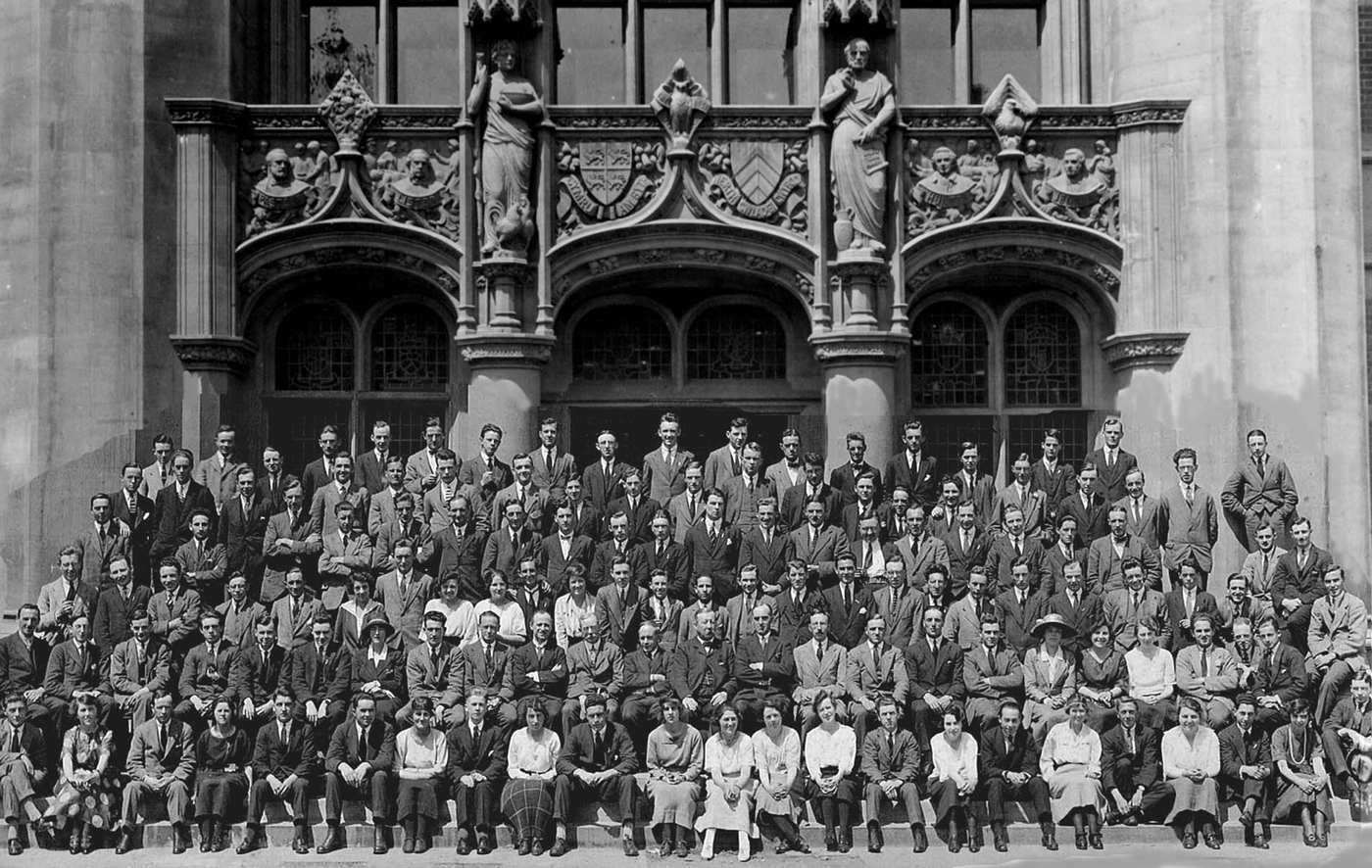
Fig 1.Students and staff at the Physiology Institute,Cardiff, 1920.TGB is centre, second row from the front. Many, including TGB, had recently been discharged from Military service. TGB’s climbs were planned in his library at the top of the Tower and after his retirement he lived there for another 14 years.

The Protagonists.
Graham Brown (1882-1965) joined Charles Sherrington, later a Nobel Laureate, in Liverpool University in 19102 later moving to Manchester before volunteering for the RAMC in WW1. Specialising in stress illness (shell-shock), he served on the Salonika Battlefield until 1919; then Cardiff’s Physiology Professor (Fig 1), Dean of the Medical School and Fellow of the Royal Society. Lord Adrian, his obituarist, and also a Nobel Laureate, described TGB as a formidable opponent, particularly of University bureaucracy, who did not conceal his pleasure in the fight and victory. As Editor of the Alpine Journal (1949-53) he published a sympathetic obituary of Smythe.
Frank Smythe (1900-1949) was training as an electrical engineer in London and came to Bradford in 1919 for practical experience. He met Howard Somervell, EE Roberts and Claud Frankland on their way to climb at Almscliff. The following year he climbed on Pavey Ark, Little Gully and a solo Eagle’s Nest Ridge, Great Gable. Later resigning from a post in South America he joined the RAF but was discharged medically unfit. He spent his gratuity climbing and writing3. When discussed as a candidate for the 1922 Everest expedition Howard Somervell described Smythe as “A bad mountaineer…. an intolerable companion. Nobody in our party could stand him for more than a few days”. A more sympathetic appraisal is given by Stainforth in a review of Six Alpine Books.4


Fig 2. Langdale, Easter 1923. Left to right, E Griffiths, TGB, AA Scott, W Petty, HW Hodgkinson, with Club swastika emblem on his cap,C Wood (front). 
With permission, Gritstone Club.

Was TGB paranoid?
Charles Houston suggested that TGB was paranoid due to altitude hypoxia. This was based on his observation, as a medical student, of TGB on Nanda Devi in 1936. While high altitude hypoxia can cause transient paranoia, this disappears with normal oxygen and can’t explain events occurring at sea level years before. A critical obituary of TGB by Lord Adrian makes no mention of paranoia.

Was TGB a passenger?
The 1950 letter to Smythe’s widow described TGB as “a nervous beginner”, “an absolute tyro” who irritated Smythe by “making constant notes and talking incessantly about mountaineering problems”. These grounds for a feud seem spurious considering that, after their first climb, Smythe climbed again with TGB on Clogwyn d'ur Arddu and on the successful route Major climb in 1928. Was TGB really such a passenger or did the writer have other axes to grind?
Compare the writer’s comments with those of TGB’s longer-term climbing companions in the Gritstone Club from 1923-30. Eric Griffiths5 and Cecil Wood founded the Club in 1922. A.A Scott (Fig 2), the second president, was an engineer who produced innovative water-cooled motor cycles, sought after by today’s collectors. Scott designed the club badge based on the prehistoric Ilkley swastika (Fig 3). The Lake District in those days saw climbing authors George and Ashley Abraham still active. George Basterfield (1877–1949), Mayor of Barrow in Furness, was a leading light in the Fell & Rock Climbing Club and the Gritstone Club with many Lakeland first ascents to his name. He spent time with novice climbers teaching them why and how to climb and it was Basterfield who brought the Gritstone Club and TGB together.


The first reference to Graham Brown appears in a Walter Petty (Fig 2) report of a Gritstone Club meet at Langdale, Easter 19236. “Brown partners the more enthusiastic climbers on both rock and snow. One ice axe for the entire party reflects their level of experience at that time”. Petty writes about their climb on Gimmer Crag, where Graham Brown was indefatigable “It is only fair to mention that our last man was the only one to come up Amen Corner without assistance. Being a professor of physiology he realised the difficulty of standing on his own shoulders. We had no instrument for measuring the exact tension of his rope as he came up the famous crab-walk so we are bound to give him the benefit of the doubt and accept his statement as correct.
Petty continued, “After dinner at the Flying Horseshoe Hotel, Clapham (Yorks) (Fig 4), a new official was created – that of Hon. Chaplain to the Club”, Graham Brown was elected as the first holder of the office. “His efforts were extremely edifying. The proceedings opened with his reading of the first lesson from the Book of Abraham – the chapter on Gimmer. The responses of the congregation (Amen) were particularly beautiful when a certain passage was read out. The effect was indescribably funny.” After the 1925 dinner, George Basterfield wrote in the Club Journal “Dr Brown appeals to me as a man possessed with the body of a respectable person and the soul of a vagabond, strange it seemed to me to listen to the free and easy drolleries of the true vagabond chanted sweetly in Gregorian cadence.” Club minutes record early annual dinners attended by TGB being rumbustious affairs continuing well in to the early hours with climbing routes put up throughout the interior and exterior of the Flying Horse Shoe with indoor waterfalls and balustrades of inadequate strength used as belays.
The 1924 Gritstone Journal describes TGB’s rock climbing in the Lakes, meets at Coniston at Easter and Langdale at Whitsuntide (with Leslie Letts, London). The first Gritstone Club visit to the Alps was in July, the party consisting of TGB, Cecil Wood and Letts and used local guides6. Destinations were Wellenkuppe, Rimpfischorn then Dufour spitze of Monte Rosa (15,217 ft). Graham Brown with limitless energy “…led the climb and insisted on taking every obstacle direct”. 


Fig 4.1924 Annual Dinner, Flying Horseshoe Hotel, Clapham,Yorks.TGB,rear,3rd from rt. E.E Roberts, 2nd from rt. sitting. George Basterfield on his left. Roberts wrote an obituary of Frank Smythe in YRC Journal in 1952. With permission, Gritstone Club.

In December, TGB with Basterfield he made the first winter ascent of New West Climb on Pillar enjoying the challenge of snow and ice climbing. In April 1925 Graham Brown and Letts have another trip to the Alps. On their return TGB was the first to discover with Basterfield the climbing potential of the rocks on Kirkfell. They named them Boat Howe Crags, making the first ascents of several routes applying boating names7, a big interest of TGB. The 1926 Gritstone meet in the Alps is written by TGB in the Club journal as “The Graian Expedition July 1926”8. His alpine experience has obviously developed and his time spent in the mountains with Leslie Letts cannot be matched by Cecil Wood and Leonard Wade (Bradford). At a Club meet at Thornythwaite, in Borrowdale, Easter 1927, TGB was training on Pikes Crag for his forthcoming Alpine season.
This confirms that TGB was the antithesis of “a passenger” and we shall see below that the letter writer had other motives for denigrating him.

Graham Brown’s perspective of Smythe

For 15 years TGB had speculated about a direct way to the Mont Blanc summit but there were no suitable photographs available. The inception of the climb is well described both in Brenva10 and in ES Herbert’s obituary of TGB11. Herbert (aka Lord Tangley), RJ Brocklehurst and TGB made their first reconnaissance in 1926. Their first sight of the south side of Mont Blanc was the instant TGB realised that this was the site of his long imagined “Route Major”.
TGB’s story of his three pioneering Mont Blanc climbs eventually appeared in his book Brenva. But when Smythe saw the proofs he threatened legal action and before publication the originals were drastically edited by ES Herbert, a lawyer and mutual friend. TGB’s 1933 analysis was a 75 page letter to Col EL Strutt, Editor of the Alpine Journal9 but never published. In fact it may never have been sent. There were two issues;
[1] Although Smythe and TGB were climbing partners, Smythe claimed much later it was not TGB who first had the idea of the new Brenva route. TGB thought that this was a ruse to mask his role in the inception of the climb. The third man turned out to be TS Blakeney (1903-1976) described in an AJ obituary as having limited climbing experience. In 1928 Blakeney had joined Smythe and TGB in their first attempt to ascend Mont Blanc de Courmayeur direct from the Brenva glacier. They spent the night at the old Brenva bivouac where a persistent violent thunderstorm caused the expedition to be abandoned. Blakeney, because he was unwell, then returned home and missed the successful first ascent days later.
22 years afterwards Blakeney re-emerges as the “letter writer” and his disparaging assessment of TGB was based on this episode. Bearing this in mind there is a striking difference between TGB’s vivid description of the Brenva route and the vague description by Smythe and Blakeney. TGB noted that when they first climbed the Sentinel route Smythe had no clear idea of the topography of the Brenva face. When preparing his talk on the Sentinel route to the Alpine Club, Smythe, although critical of TGB’s constant note taking, wrote 16 letters to TGB for clarification, but with no mention of Blakeney’s “discovery”. Smythe’s first mention of the Blakeney idea to TGB was eight months after they had climbed the Sentinel route. When TGB confronted Blakeney his responses about “his route” were imprecise. In April 1928 when TGB went to Pen y Pass and met Smythe with Ogier-Ward, he was surprised that Blakeney, as “the originator” of the idea, was not in the party for the new 1928 Brenva route (Ogier-Ward, Smythe, Macphee and TGB). Macphee was rejected by Smythe and Blakeney was rejected as being unfit, not by TGB but by Ogier- Ward. Finally TGB described how he, Smythe and Blakeney had climbed the Trident de la Brenva specifically to examine the face for the 1928 climb (letter p40). But it was incredible to TGB that Blakeney himself made no mention of previously carrying out a reconnaissance of this specific route with Smythe.
[2] The Major route was eventually climbed by Smythe and TGB alone on 6-7th Aug 1928.Immediately afterwards TGB broke his partnership with Smythe and never climbed with him again. He kept the reason to himself until 4 years later, after he first heard of Smythe’s story how he had saved TGB’s life on the 1928 climb. TGB claimed, in his letter to Strutt, that this story was a fabrication and the reverse of what had actually happened (and the probable cause of the feud).
Both Blakeney and Herbert independently described Smythe as being in a nervous state in 1928, convinced that he was going to be killed. This preyed on Smythe’s mind and when he arrived with TGB at the Montenvers Hotel, shapeless bundles containing the dead bodies of husband and wife mountaineers were being carried past them on poles2 (p119). TGB claimed that to prevent damage to his reputation Smythe concealed the reason for the broken partnership with a distracting story about how he saved TGB’s life on the climb, and this was repeated to TGB’s publishers in 19432 (p930). Repeated twice in the Appendix2 there was, remarkably, neither mention of the incident in Smythe’s 1928 Blackwood’s article nor in his version of the 1928 climb. TGB claimed the incident was Smythe’s invention (letter p62-64), and wrote to Smythe to remind him of the facts of their severed partnership. Smythe replied with a letter about the critical phase of that climb, reproduced in Appendix IV2 (p926-928). The latter described the events as if TGB was not actually there.
Smythe claimed to have led at the critical part of the 1928 climb whereas TGB is adamant that he saved the day when Smythe panicked. TGB may not have been an expert climber but he certainly knew about stress related breakdown. TGB describes the traverse on steep ice at the final buttress (letter P65, para 4) “We had great difficulty at the corner and we both failed. Then I gave Smythe my shoulders in his crampons…he cried out and fell….”. TGB tried and failed, Smythe was hysterical and thought even a descent was questionable. TGB spoke to him sharply then led the ice traverse of about 110 feet and shouted to Smythe to follow. Smythe replied “How did you do this” and “why don’t you encourage me”. TGB, “We walked up a short slope to an easy looking chimney. Smythe went ahead but slid down and cried out “Now we are finished, and its all your fault. You have sacrificed my life” (letter, footnote p67)”. TGB’s edited account of this is in AJ 41, p45.
Some of TGB’s responses to the Smythe letter reproduced in Appendix IV2 (p928) are as follows (Strutt letter, P69); Smythe in italics, “Then you tried but ….your crampons made holes in my coat”. (TGB –untrue, it was the converse). “This meant an extremely hard bit of cutting on..steep polished ice…after so much previous cutting”.(At this point Smythe’s editors2 remind the reader that “Smythe forgot that Graham Brown led this critical passage as he described in Climbs and Ski Runs”).My arms were tired from hours of cutting…” (TGB- Smythe had not cut a step for at least 2 hrs because they were a long time at the corner where they both failed). TGB concluded that if Smythe really had led, most of his account of the climb would have been devoted to this traverse. Smythe’s book made no allusion to the difficulty.

A Question of Attribution.

Early Gritstone Club Dinners (Fig 4) were held in what was later Alan Bennett’s Yorkshire village; his above named play was based on the Queen’s art advisor and his role in the Cambridge Spy Ring; a sub text touches on fakes and secrets. During the restoration of a painting depicting two figures a third is discovered under the paint, and later, a fourth and fifth. This resonates with TGB’s story. Blakeney, the third man in the story, ventured into print about “his route” only after TGB’s death. Then, rather than confirming Smythe’s repeated claim that “Blakeney first suggested the route”, he “proved” the opposite; that it was that Smythe who thought about the route before TGB. The basis of this “proof” was that Smythe showed Blakeney, in the autumn of 1927, photographs of the Route Major. Unfortunately for Blakeney he had forgotten that these were TGB’s own photographs taken on the first Sentinel climb and loaned to Smythe. Remarkably this episode was described by TGB in his 1933 letter to Strutt. In fact Smythe never claimed that the route was his idea.
So why was Blakeney so keen to rubbish TGB’s climbing ability 22 years after the major climb? When he wrote the letter, TGB was the editor of the Alpine journal and Blakeney an assistant. Blakeney’s letter to Smythe’s wife revealed that he had other axes to grind. It enclosed a letter from Blakeney to BR Goodfellow, criticising TGB as editor of the AJ; “For all along I have maintained that it may be necessary to get rid of G-B as editor”. Blakeney makes TGB a scapegoat as a hopeless climber and editor. Lord Tangley (the fourth man?) himself had belittled TGB’s climbing ability in his obituary. But a personal communication from Dr Robin Campbell, University of Stirling, said, “I don't agree with what Tangley12 says about the disparity in climbing ability between Frank Smythe and TGB. They were both excellent climbers: proof of this is the fact that in Whitsun 1928 they very nearly made the first ascent of the West Buttress of Clogwyn d'ur Arddu, the most difficult climb achieved between the Wars in North Wales”. A few years later an unsigned paper critical of Winthrop Young (the fifth man?) was wrongly attributed to TGB. This precipitated a storm of criticism of TGB from five of his enemies who, within three weeks, “independently” wrote critical letters to Tangley. TGB was in hospital and unable to reply to Tangley, who rather than giving him a rap across the knuckles, sacked him from the editorship. Blakeney later admitted writing the paper but he was not finished with TGB. In his 1976 history of AJ editors13 the Machiavellian Blakeney, seething with bile, gloats over TGB’s downfall which he was instrumental in organising.
Graham Brown and Frank Smythe established two fine climbs on the greatest face of the Alps but were unable to share the glow of their success. Smythe subsequently completed many books on his climbs and Graham Brown his triptych of Mont Blanc routes when he added the more difficult Brenva- Via della Pera in which Smythe was not involved. 


Drawing of the prehistoric
left facing Ilkey swastika.
Right: Gritstone Club Badge used until 1960. With permission, Gritstone Club.


Acknowledgments

W. Hinde, Gritstone Club for three figures and transcribing Club records of TGB’s early climbing club history 1923-30. Trustees of the National Library of Scotland and John Bowles, Curator of its Graham Brown Collection. Mr. Glyn Hughes, Archivist at the London Alpine Club, for providing selected documents of the Editorial Committee of the Alpine Journal.

References
  1. Graham Brown T. Brenva. 1944. London JM Dent & Sons.
  2. Smythe F. The Six Alpine/Himalayan Climbing Books. Appendix IV, 924-932. 2000. Baton Wicks, London.
  3. Jones JG et al. Thomas Graham Brown (1882–1965): Behind the Scenes at the Cardiff Institute of Physiology. Journal of the History of the Neurosciences. 2011; 20:188–209. http://www.history.qmul.ac.uk/research/modbiomed//Publications/57216.pdf
  4. Roberts EE. Francis Sydney Smythe. YRC Journal.1952;7:327-8.
  5. Gordon Stainforth. Review of Frank Smythe: The Six Alpine/Himalayan Climbing Books. The Alpine Journal, 2001
  6. Griffiths E. The Early days. Gritstone Club Journal 1963:1-6.
  7. Petty W. Gritstone Club Easter Meet, Langdale 1923. Gritstone Club Journal 1923;2:1-10.
  8. Letts LC. The Alps 1924. Gritstone Club Journal.1924;Vol 2, No 2.10-19.
  9. Graham Brown T. Boat How crags, Kirkfell. J Fell Rock Climbing Club.1934. Vol10. 1-14.
  10. Wood C. Boat How Crags, Kirkfell. Gritstone Club Journal.1925-26;2:28-9
  11. Graham Brown T et al. The Graian Expedition. Gritstone Club Journal. 1926:3:1-6.
  12. Prof T Graham Brown. Inventory of papers. AC4338. Nat Lib Scot.
  13. Herbert ES. T Graham Brown. Alpine Journal. 1966.71: 51-57.
  14. Blakeney TS. The “Alpine Journal” and its Editors. Alpine Journal. 1976; 81:153-160.

Biographical Note.
Published a personal experience of acute altitude hypoxia; The Hypoxia Hilton. J R Soc Med. 2002; 95: 606–8. Reviewed Mike Ward’s book on Everest, J R Soc Med 2003; 96: 417-8. A Review of T. Graham Brown’s Life. 2011. at http://www.history.qmul.ac.uk/research/modbiomed//Publications/57216.pdf

Gareth (JG) Jones 2013 

Friday, 22 February 2013

Cornish Connections


This week, as a tribute to veteran South West climber, Mike Banks who died recently, the republication of his 1995 High article-Connections- which looks at the historical links connecting the early days of South-west exploration to the modern era.


The figure silhouetted against the skyline on the Bosigran cliff top was clearly that of an elderly man, his white hair blowing in the wind. The year was 1947 and I was being trained to become a Commando cliff climbing instructor. The Cornish coastline was a very empty place in those days; strangers were noticed. I was told that he was Arthur Westlake Andrews, who lived a few miles away. He was, I gathered, the founding father of Cornish climbing.

Not long afterwards I joined the Climbers' Club and realised that Andrews was the custodian of the Count House, the Club hut at Bosigran. He was a friendly and hospitable man, always interested in what was developing in Cornish climbing. Despite the disparity of our years — I was 25, he was 80 — we got to know one another. I would be invited to his house at Tregerthen, next door to Eagle's Nest above Zennor, where he would show me faded photographs taken in the Alps in the previous century. Together with his sister, Elsie, we would hold grave discussions on the etiquette of the Cornish cream tea. He held strongly to the view that the jam should be put on first, then the cream on top.

Andrews was the quintessential English gentleman mountaineer, educated at Charterhouse and Oxford where, of course, he read classics. A notable all-round sportsman, he attained national standard in athletics, winning the mile in Berlin. In tennis he got as far as the semi-finals of the Men's Singles at Wimbledon.
At Magdelan his rooms were above those of Coolidge, the eminent if fractious Alpine mountaineer some 20 years his senior. Through him Andrews became acquainted with mountaineering and from 1890 was active in both the Alps and the British hills. With Archer Thomson he was to produce a guide to Lliwedd.... the first Welsh guidebook.

It so happened that Andrews spent his holidays in Cornwall staying with his uncle who lived at Zennor. Having taken up moun­taineering he naturally examined the coastline with a climber's eye. In those early days the Alps were all the fashion. The British hills were widely regarded as a convenient form of Alpine training. Mere outcrops were dismissed as 'scrambles'. It is interesting that Andrews and Tom Longstaff, both West Country pioneers, initially opted for long coastal traverses. I suppose that the ascent of a cliff appeared to them ridiculously short whereas a long coastal traverse might offer a rock climb of near Alpine length. Indeed, Andrews harboured the ambition, never to be realized, of traversing the whole coastline of Britain. He also devel­oped the practice of climbing in gym shoes for which he deserves great credit. It enabled climbers to make far harder friction moves than was possible in nails. Remember that Vibram soles did not appear until after World War 2.

Even so, vertical routes were not neglected and Andrews made the first climb on nearby Bosigran in 1902, the Ledge Route. Cornish climbing, as we recognise it today, was born .Andrews went to live at Tregerthen in 1922 and continued to climb actively. Through him the Climbers' Club acquired the Count House at Bosigran in 1938 and he became the first custodian, always showing great warmth and interest towards visiting climbers. The hut gave a stimulus to West Country climbing and focused it firmly on West Penwith, perhaps retarding the devel­opment of other worthy West Country areas.

Zeke Deacon leading Monolith Slab: Rosmergy

I move on now to 1957 when I was in charge of the Commando climbers and often teamed up with the redoubtable Zeke Deacon on the lookout for new routes. On one occasion we were virtually provoked into a new route by Andrews. In 1923 he had traversed into the Great Zawn of Bosigran and had written that, if the ledges on which he had seen cormorants perching could be connected, then a notable route might be created. He urged us to try it. The Green Cormorant Face route resulted. It should be remembered that we were in the pre-nut era but  thankfully, rock boots had been invented. Artificial climbing was the flavour of the month. Zeke, who of course led, used several pitons with etriers on the first pitch. Even so, I found it at the limit of my ability. In any case, the second's job was no doddle. His task is to get the pitons out and doing this swaying on a wobbly ladder, walloping a peg at ankle level was both acrobatic and exhausting.

We duly reported back to Andrews and received his congratulations with an accompanying cream tea. Now Andrews was also a poet and a few days later a poem arrived in the post in which he parodied Flecker's famous lines on the pilgrims setting off on the Goldern Road to Samarkand. He was making a wistful, but not judgmental, comment on 'progress' in climbing technique; a lament at the loss of innocence perhaps. Looking back to his early Cornish years he asks:

Who are these beggars in their ragged clothes
And old felt hats and roughly mended hose
Who wear old pairs of worn out rubber shoes? 

 He gives the answer:

We are the pilgrims of a bygone age
Who traverse on the shore from stage to stage
In lust of seeking what no man has seen
Between Bosigran Head and far Pendeen.

But what of these Commando climbers?

Laden like Tartarin with all the gear
For storming citadels that climbers wear
Pitons and karabiners, ropes and slings,
And everything except pair of wings.

They reply:

We are professionals and this crusade
Is but the usual practice of our trade.

It is interesting that the use of pitons, which had inflamed British climbers when used by Germans on the Munich Climb on Tryfan in 1936, were approved by the climbing establishment in the 1950s. Might there be something prophetic in this if applied to the bolt controversy and might not Andrews's tolerant reaction have a message for today? Andrews died, ripe in years, in 1960 to be succeeded as custodian of Bosigran by another quite splendid old gentleman, Rear Admiral Keith Lawder. Keith had retired from the Navy at the age of 55 and taken to climbing with infectious enthusiasm. He was the most amiable of men, always ready for a joke or a prank. In fact the Admiral had never ceased being a Midshipman.


Rear Admiral Keith Lawder
  
I remember a naval club meet based at Bosigran. Keith, looking outrageously scruffy, was at the sink washing up. A young able seaman came up to him and said: "Wotcher Chief, what's this buzz about some bloody admiral coming on this meet?" With his conspiratorial grin Keith replied: "Don't worry. I hear he's not a bad old stick."
When he was well into his '60s, Keith set about exploring Lundy with Ted Pyatt. His memorial as a climber must surely be his first ascent, at the age of 68, of the incompa­rable Devil's Slide (Severe). It is arguably the finest slab climb in Britain. Whatever his or her talent, it is a route that any visitor to Lundy, who has an eye and a heart, must feel impelled to climb.

One of the most joyous climbs I have ever done was to repeat The Devil's Slide with Keith Lawder, then in his 79th year. The third on the rope was his grandson, Iain Peters who, instead of playing childrens' games, had since his early youth, been taken out on climbing adventures by his adored grandfather.
I have climbed with Iain, mostly in the West Country, from his boyhood until he blossomed as a climber. He is the author of the current guide to North Devon and Cornwall and the architect of many first ascents in this area.

So, from my youthful acquaintance with Arthur Westlake Andrews to my avuncular climbs with lain Peters, I seem to have spanned West Country climbing from its inception to the present day. It is a kaleido­scope vision. The '50s and '60s were rich decades. Three Commando instructors were pre-eminent: Zeke Deacon, Vivian Stevenson and 'Mac' McDermott. They climbed in the friendliest of rivalry with Peter and Barrie Biven and Trevor Peck. The guidebooks are witness to the rich harvest of their routes. The Commandos tended to fade out from the '70s onwards when their role changed from cliff raiding to Mountain and Arctic Warfare and they were less in evi­dence.

Of course there has been no let-up in the development of the area. Improved equipment, techniques and training methods have pushed up standards. New routes have prolifer­ated in the West Country as elsewhere.
I suspect that all climbers of mature years have one range of hills, or a particular crag, to which they instinc­tively return for solace. Unhesitatingly I head for West Penwith. It has given, and continues to give me, so much. It is, of course, greatly changed from those far off days just after the war when the Bosigran face and Chair Ladder were crying out for detailed exploration and Carn Barra was virgin ground.

The dreamlike quality of the far west is vanishing. The old friendships have given place to the acrimony that bolts seem to bestow and the environ­ment is under siege, eroded by climbers' feet and scoured by the gardening of routes. Long ago I remember the raven's nest on Bosigran that gave the route, Raven's Wall, its name. It is long gone; no longer do buzzards soar over the Great Zawn. I must leave the last word with Andrews who, decades before the environment became an issue, wrote:

Will there be ravens on Bosigran still and has the buzzard got his usual nest in the Great Zawn, or will they too have passed, To other hunting grounds with all the rest?

Mike Banks 1995 ( First published in HIGH 153 August 1995)