Friday, 1 May 2015

The Haunting


Some winters ago Eric Langmuir, John Disley, John Cleare and I stayed at Ben Alder Cottage, en route for Fort William to Dalwhinnie. This is one of the finest bothies in the Highlands. And Eric, jokingly, warned us that it was haunted. He told us the story of a visit which his sister Marjorie, then a medical student, had made to the cottage with a party from Glasgow University Mountaineering Club. During the evening they heard footsteps outside. They went to the door and looked outside. No one there. And then it happened again. Still no one there. Some months later I told this story to a very eminent Scotsman. A strange look came over his face and he told me the story of his visit to Ben Alder Cottage, before the war, when he was a boy. That story has remained forever in my mind. Recently I persuaded him to tell it again — the most astonishing story I have ever heard. The only fact that is concealed is the name of this eminent Scotsman because he is fed up with having his leg pulled. I can, however, assure readers that this is no leg-pull.


It was in about 1937. A great friend of mine who had walked with me the whole way from Glasgow to Skye in 1930 and with whom I had climbed in the Cuillins, those most delectable of all mountains, told me that he had heard two of the tougher anglers, who fished the more difficult places in the Highlands, talking about the Loch of the Buich Pass. The name entranced us and we wondered where this place was where these marvellous trout could be caught — up to 3/4lb at 2,400ft. Where was this Loch? Tom- my friend- worked in another Department of the Corporation of Glasgow, but in the same building as I did and one day he came up the stairs into the drawing office where I stood as a young apprentice civil engineer and said: "Bob, I've got it. I've been looking at the one inch maps and it's Loch Bhealaich Bheithe — Loch of the Buich Pass in the Gaelic. A mountain pass between Beinn Behoil and Ben Alder. Let's go there".

So we did, in 1938, and we came up on his old motor bike with me on the pillion and we left it at Bridge of Gaur on Loch Rannoch. From there an old stalking track went for, I suppose, six or seven miles across this wild moorland through a dying forest — a stark, white-bleached remnant of an old Scots pine woodland area. The track stopped as though it had been cut by a knife in the moorland and after that only rough moorland for a mile. And we came over this rise. Tom had a little pocket telescope which had been given to him for some occasion. We lay there on the ridge and looked at the hut we had been told about or had heard about: Ben Alder Cottage, this old Butt'n Ben.

No smoke came from the chimney, no curtains were in the window. We reckoned it was a good house, the kind that we enjoyed living in. So with some circumspection, we made down the hill,that long beat down through the dying remnants of this old pine forest, and forded the River Alder — which can be very dangerous when it is in spate. But was quite easy that day,and walked up with great care — because we were old hands at reconnoitering howffs. Here was Ben Alder Cottage, But'n Ben, a room and kitchen and we made it our headquarters for nearly a week. A little porch giving access to a minute six foot square hall: to the right a door into the kitchen and to the left a door into THE ROOM and straight ahead, one little bedroom without a window — a standard highland butt'n ben, tongued and grooved lined with wood for warmth, the ancient equivalent of a highly insulated house. And attached to it was a barn, in line with the cottage, which once had had two compartments with a wooden partition between the two and two doors but which a generation or two of stalkers had broken down to use for fire wood when they were caught in bad weather.

This place was eight or nine miles from Bridge of Gaur and fifteen miles from Dalwhinnie, most of it on a rather difficult track each way. It must have been one of the most isolated cottages in all the highlands, lying at the foot of Ben Alder with a great number of Munros lying around it which we wanted to climb and hadn't climbed. Now in those days, we found that we could only carry in about three days of food in a 45lb pack when we included our stove and sleeping bag and a tent in case we could not find a howff. So we were limited to three days. After that you had to live on the land and the land meant the water. So we both carried American three foot section steel spinning rods with a primitive spinning reel, gold and silver Devons to fish these unsophisticated hill Lochs because we knew we could catch them, three or four to the pound, sometimes a half pounder, on a rare occasion a three quarter pounder.

We learned to eat them in various ways. We mashed up the fish with'oatmeal and made fishcakes of them, we broiled them, we boiled them, we fried them. We did all kinds of things with them. By the end, when we were drawing in these fish in the spinning reels from the hill lochs we had to turn our faces away from them as they came weaving in through the brown shallowing waters. We couldn't face it — the thought that we had to eat the bloody things! Now this loch was the one that we'd heard of you see and it was a marvellous loch. We actually caught up to three pounders on it, which was a very big fish for a loch which was something like 2,300 ft above sea level. This was the pass over which Prince Charles Edward Stuart had walked when he was escaping from the post-Culloden situation and he had come down to an old hut or crofters house known as "Dooms Smokey Place" which had stood on the site of Benaider Cottage — we could trace the old foundations.

Now according to the records Prince Charlie had slept one night in this "Dooms Smokey Place" before going up to Cluny's Cage where he had spent some time with Cluny MacPherson and his clansmen and they hid him and fed him there in the days after Culloden — before he eventually escaped in a French Man o'War and ended his rather inglorious life in France, on brandy. This was the spot on which we slept. For some reason which I can't remember now, we used to sleep in the kitchen where we could build a big fire of the wood we carried across from the dying forest near the side of the Alder Burn. One day we did the ridge that lay along the glen that ran down to Loch Ossian and when we came down to it, we produced as always from our rucksacks our spinning rods and we caught a few little fish, so unsophisticated that they were trying three at a time to get on to the hook. We caught a number of them and brought them down and unwillingly, as always by that time, mashed them up and made a meal. There was only one article of furniture in that house, a table. 

We put it against the window in the kitchen — to the right of the front door — and in the corner of that room, away from the fire, which used to blaze at night flickering in the tongued and grooved brown varnished lining. We made a bed of heather and there we slept at night in our sleeping bags. Now we sat at the table with a paraffin primus stove between us, roaring away, and we made our meal, our tea. And as we sat there doing that, I thought I heard someone coming in through the little porch past the door which was only two or three feet from my left elbow and he went into the room on the left! I said to Tom: "That sounds like someone, d'ye hear him?" And we both sat there in the dusk and he said: "Well I can't hear anyone". And we thought nothing more and we had our meal. We built up the fire and in the warmth of the fire we lay in our sleeping bags on the heather. We lit our pipes — we were both great pipe-smokers.

Now before heard this sound, I had gone through to get Meta Mitre fuel to prime the stove and after the meal was over, Tom said: "Damn it I've run out of tobacco but I've got another tin, away through and get it". And he went through to the other room where we kept our rucksacks. I was in that marvellous state after a wonderful mountain day — lying back in a sleeping bag smoking my pipe, a feeling of great luxury. | was aware that Tom was standing at my feet and I looked up sleepily. He had a very curious expression on his face and I said: "What's wrong, Tom?" And Tom said: "Did you see this on your rucksack when you went through to get the meta fuel earlier on?" And he gave me a piece of paper. This piece of paper had written on it: "You must leave this house immediately — you are not permitted to stay here". 

And there was a name, I think it was Macintosh, Head Stalker. Tom said: "You must have heard someone after all. But why didn't he come in? We would have given him a cup of tea and argued him out of it. We can't leave here at this time, 10 miles from the nearest road". Well that was that. We lay down again in our sleeping bags, smoked our pipes and thought about it but not too much. Well, by this time it would be about midnight and dark and suddenly it was Tom who heard something and he said: "There is someone through next door". And we heard this sound of a man going, bwmm, bwmm, like someone walking and then a great whrrr like a big heavy piece of furniture being pushed and then, bwmm, bwmm, and then, whrrrr. And we lay there and listened to this and we were really quite frightened.

I said: "But why doesn't he come and tell us we've got to go. We'll give him a cup of tea and talk him out of it?" And then it became intolerable. I suppose we lay there and listened to it for many minutes — ten minutes, a quarter of an hour, in a kind of increasing state of fear and uneasiness, and then we got out of our bags and we took hold of our torches, opened the door of the kitchen, went through a little hall and listened at the door and we heard this man, this thing, this whatever it was, walking quite definitely: bwmm, bwmm, bwmm then whrrrr as though it were some great heavy piece of furniture in the room. We threw the door open and shone the torches in — it was dark, it was midnight. But there was nothing, not a thing, and we walked into that room and we were really terrified. 

And then we thought it must be next door in the byre which was now one great compartment paved with stones, great flat stones as far as I remember. As we stood there we heard the sound in the byre,through the wall, only this time it was as though someone with tackity boots, nailed boots, walking on the stone floor, clink, clink, clink and then whrrrrr. A heavy thing being pushed. That was how it presented itself to us, to our imagination. We really were terribly frightened and I remember looking at Tom and if his face looked like my face than it was really a study: pale, frightened with great round eyes. We went back out of the door into the porch, out the front door and this black, velvety, starless night fell upon us. We moved up the side of the house and there were two doors which led into the one compartment because the old partition between the two sections of the byre had obviousiy been torn down over the last decade or so for fires by people benighted.

We knew it was one compartment so we opened the two doors simultaneously and before we did so I said: "It may be a stag or something that's got in". But we knew it was lunatic idea. We threw the doors open simultaneously each one of us. There was nothing, not a thing. We went in. We went right round it, there was nothing and the sound had stopped. The next morning, we climbed the walls of the cottage onto the roof and we dropped stones down both chimneys to see whether there was anything hanging from the chimneys. Nothing. I may say that we wasted no time getting back to Bridge of Gaur the next day. Years after that, having told this story to another great friend of mine, a keen photographer, hill-walker and fisherman, we made the same journey. This time we didn't sleep in the kitchen, we slept in the room where in the original incident, our rucksacks had been. And we lay there with our heads to the back wall and our feet to the window which was nailed up. In the middle of the night I woke up in blackness, dense blackness, and I heard a man walking on the pavement — there are flat stones along the side of the wall if I can remember correctly.

I was aware, as though in a nightmare, that he had stopped and was looking in through the black window on both of us. In a state of terror, absolutely stupefying horror which I cannot explain in words, I woke McCallum up, I remember his second name, and he heard the end of the footsteps and then everything stopped again. Two years after that, McCallum went with another friend and he woke up in the same room, feet to the window and was aware that there was a great light shining through the window. It was as though the sun — and this was in the middle of the night — were at the back of the window pouring a flood of light into the room and he was afflicted with this same overpowering sense of horror as I had felt.

And then it cut like that and went off and that was the end of that. Now this original friend of mine with whom I had had the first experience, Tom, had married in the interim, and he and his wife with whom I was very friendly, and I went up there to fish and climb and we met another couple who'd come down from Dalwhinnie. Tom & Jessie slept in the room in their sleeping bags and I slept with the other couple in the kitchen and we made tea, me and this young couple, and we blethered and talked away for a time. When we went to our bags we couldnt get to sleep for the noise of Tom and Jessie wandering about in the next room. They disturbed us and the next morning when we were all having breakfast together in the kitchen, we said to them: "What were you up to last night? You seemed to be moving about a lot". And that said: "Moving about? We didn't move about. We got down right away into our bags. We could hardly sleep for you moving about". Well, that is the story. We never could equate that material and physical piece of paper which must have been written by a real man with the other things that happened. Of course many of my friends have given all kinds of debunking explanations for it. But none of them fit — no, we didn't have any alcohol with us. I simply record what happened. I know of no explanation. 

Anonymous: First published in Mountain life-Dec 74.

See 'The Truth about McCook's Cottage' which relates further haunting experiences at the bothy.

Friday, 24 April 2015

Alternative Slate


Photo:MaryMary

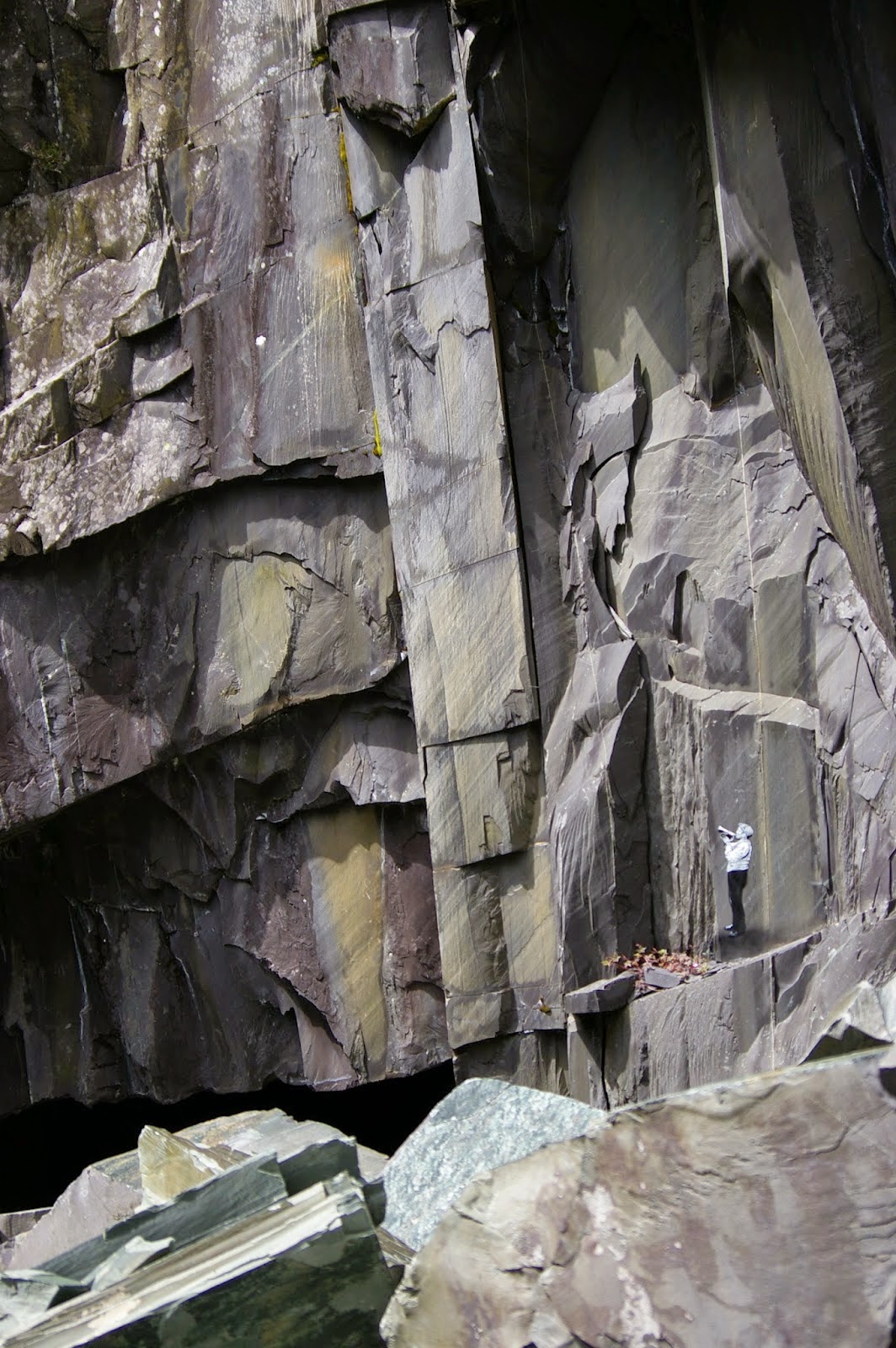
Geography mutates inhabitants: the quarrymen, generation upon generation, dug in, taking hits and diminishing the mountain for the demanded slate; day after day, lung after lung, producing a lethal strain in the indigenous population. A package deal of volatile deliverance and bought pleasure from Ebenezer's Kingdom. Time left those dusty appendages and tale full jars to eke out in some other field. They left a huge dead quarry, into which the micro-quarrymen came; reluctantly at first, to work and play and exert their recreational rules, and again, to become prey to a different sort of mutation — a more intellectual, dare I say, "artistic" Manic Strain!

The rock-climbers, tier upon tier of them, are the micro-quarrymen, milling about their business on the faces and slabs, like termites — feeling and probing. The demand to cap roofs around the world, has left this place a climbers' paradise, or perhaps a climbers' dungeon?  A dungeon of climbers, some touching, some hacking this friable substance — some tentative, some robustly forging lines — exerting their own character on the structure left behind. "Love Sculpture" as someone put it! Creative sculpture does exist here — it's also matched by blatant thuggery.


There are no rules for production here. There are no lines drawn between the poet exercising his urge and a team of navvies next door, hell bent on ascent! Each justifies their Strain. The difference between a wall where there was nothing, carefully chipped to produce a series of moves that give the discerning "dancer" unsurpassed climbing pleasure.....Manic Strain, E7 6b/c and a climbable line, cleaned and chipped to produce an easier route for the first ascentionist, lies in the former being a series of subtle, aesthetic changes, that neither looks, nor feels, chipped, as opposed to blatantly produced jugs.

Both are bolt protected, and both valid. This is the essence of the quarry activity. The movement is constant and without constraint. It is both honest and deceiving; both aesthetic and ugly. Just like the light on wet, varnished slate clearly defines shape upon shape and changing depths of reflected colour from strange sources. It cannot stand still — it is with the stroke of movement. As for the mentality, it is obvious. A tiny flake is levered off whilst cleaning, producing a better hold or nothing at all. On the former you make it secure, and give it the wire; but on the latter, you could have a choice? You want the line to go, it's yours, a lot of effort, the expense of bolts — you say, "it will go", and depending on the `strain' acting on you, a hold is chipped, or you can leave it for someone better? This choice, brought about by Slate's limited, but intense history, just isn't applicable.


This isn't Clogwyn du Arddu. We are here on what's left of the destruction of a hillside- a mountain — you don't even consider the environment. This is "all the throes of climbing pleasure", unrestricted amidst a moraine of slate debris, of oil drums and iron bars, skeletal machinery and stacks of discarded nude books. There cannot be any respect for the rock, giving unlimited lines from the Lake Padarn to the clouds. Will it hell be left for someone better — the better are too busy doing their own thing, and anyway, you, already have a name for it! Do you not find this sinister in its possible encroachment down the Pass? There is room here for conjecture. Like the lad who's just started climbing — straight into slate, on an abseil rope, with tools and excavating equipment, producing minor routes, with no experience, or "apprenticeship", no feel of what's gone before, and elsewhere. Caught by colour and proximity, dug the style, and hitched straight in.

Could there be a strange, twisted analogy here of a quarryman's son, destined to spend his days with the dust, with like-minded disinterested in the Welsh mountain surroundings. A slate breed- a mutant. Differing circumstances, differing strains-same quarry: Right here on the ravaged hillside, in a throw from Pete's Eats are ten-fold “Cloggy's", from Dinorwig's Big Hole and of above, down through Australia, and Dali's dip to California — to Serengetti, tier upon tier down to the Rainbow Slab Area, and in across, and down inclines to the more accessible Vivian Quarry. Yawn! Don't relax there’s a Steerpike around every corner.


A lot of unstable characters play out their visions and anarchy here; one indeed seems to forget the 'link' with climbing. Tests indeed. Offset and lethal waves fusing out of the surroundings — characters can be changed and possessed as easily as winding up a Power Station official. Perhaps from a fictitious "Arfonwy Roberts", bent double in 1806, for the pleasure of some unknown "Dust Queen", high up in a tunnel near the Big Hole. Lines were lost, goitres were brown — a strain embedded into the rock — their character and lives permeated into every fought for vein; its greyness exuding their dangerous misery.


John Redhead on 'Menstrual Gossip-E7

The pounding of ancient powdery hard-ons in remote cutting sheds (listen) — cut-throats and camaraderie, of manhood, the depraved and the proud. All etched indelibly for your young prancing limbs on smooth slabs. And the climbers, so young with the dust they haven't learned to cry yet. But each one that steps up the tiers or inclines, and jokes along the levels, as before, is tracing a destiny; is being absorbed by the oozing spirit of this place — in dark cave, or hanging flake, the clanging of real men about their work, with their problems and perversions, is stilled before them — ever-present and affecting. Varnished by rain, or dulled by dust — You can skip out — a mutant at every level. May the Manic Strain be with you. 

John Redhead : First published in Climber-Nov86. Photos JR collection unless stated.

Photos available from JohnRedhead Org

Friday, 17 April 2015

Long Views in the Hills


Cross Fell: Delmar Harmood Banner. "Perhaps the worst viewpoint in England' HG. Image Lakeland Arts Trust.

Ever since a sparkling August dawn in 1930 when two of us, after a night on the summit, saw- unmistakably, on the far northern, western and southern horizons- the mountains of Scotland, Ireland and Wales from the top of Scafell, I have been interested in long mountain views. Many of us have caught glimpses of extremely distant peaks from alpine summits or seen the far Himalayas- almost unbelievably high in the sky- from Indian hill stations, but it is more the inter-visibility of British hills that fascinates me nowadays. How far can we see in the hills on the very clearest days? What are the maximum visual contacts from our highest mountains? Can you see right across England, from sea to sea, from any mountain top?

Towards the end of our appallingly wet Lake District summer I had a letter from a friend reporting "an unbelievable view, from sea to sea" from the scarcely-obvious viewpoint of Nine Standards Rigg above Kirkby Stephen. Perched on this modest two-thousander, close to its line of Dalek-like stone cairns, he was sure he could pick out both the Solway Firth to the north-west and Hartlepool power station on the east coast and, since there are long valleys down which to peer on either side, I'm sure this is perfectly feasible. Indeed, Kipling has a character in Puck of Pook's Hill claiming to have seen both seas from some Pennine height and, if you work it out, you will find that the theoretical maximum distance for inter-visibility between the Rigg and sea-level is something like 65 miles —quite far enough to reach the coast on either side.

Further, it should be possible to see the top of any other two-thousander up to 120 miles away from Nine Standards Rigg under perfect conditions — provided there was no obstruction in between, which would be most unlikely. All this is based on purely mathematical calculations — not mine, but more of this later. About one hundred years ago the Ordnance Survey claimed that the summit of Black Combe (1,969 feet) commanded "the most extensive prospect in the kingdom" — a claim probably based on the revelation years earlier by Wordsworth, that from the top might be seen "the amplest range of unobstructed prospect that British ground commands". It has nearly always been raining when I've been on Black Combe but, in perfect weather, the Galloway hills, the mountains of Mourne and Snowdon are said to be visible from the summit. A very old Ward Locke guide of mine quotes "several of the older authorities" for the claim that the southerly view from Black Combe extended to Jack Hill near Hanley in Staffordshire, but when I mentioned this in one of my early books I was told by a reader in those parts that he did not know of any such hill around there?

Elsewhere I have read that the view south from Black Combe is the longest overland view in England and that 14 counties could be seen from the summit — before they lost many of them. Whether or not this is true I Can't say, but I do know that you can see Black Combe from ships leaving the Mersey; from the North Pier at Blackpool; from the tower of Liverpool Cathedral and from a score of places along the Lancashire coast — a great shoulder of fell standing on its own on the very edge of the sea. Scottish mountains, being the highest in the British Isles, might be expected to provide the most distant sightings and, according to the summit indicator on Ben Macdhui, the second highest mountain in Britain, both Ben Hope and the Lammermuirs which are 191 miles apart may sometimes be seen from the cairn in exceptionally clear weather.

 It is also stated in Abercrombie and Goldie's "Weather" that the Paps of Jura (2,400 feet approx.) have been seen from the summit of Hecla (1,988 feet) on South Uist — a distance of well over 100 miles. These long sightings tend to confirm the claim made to me by several people that Ben Lomond has been fairly positively identified, on a remarkably clear day, from the top of Red Pike in the Buttermere fells - a distance of something like 120 miles. 

According to the following table all these sightings are possible and, indeed, even far greater examples of extreme visibility are theoretically feasible. This table was prepared by Patrick Satow, an expert on weather phenomena
A few years ago, after I had been writing about long sightings in the hills, wondering how far we could see under perfect conditions, Mr. Satow kindly worked out the necessary calculations and produced the table. It gives the theoretical distance in English statute miles at which an object of known height should be visible for a given height of eye — "under standard conditions of atmosphere, not including exceptional refraction". 


Using the table it will be seen that the top part of Scafell Pike could be visible from 76 miles away if the height of eye was ten feet above sea-level but observed from a height of 3,000 feet — say on one of the southern Scottish Munros —the distance could become 145 miles. It should be emphasised, of course, that all these theoretical sightings depend on there being nothing in the way to obstruct the view. It will be seen from the table that the sighting distances naturally increase as the observer climbs up his mountainside but this distance increases by ever smaller amounts for each additional 1,000 feet of height — due to the steadily greater effect of the curvature of the Earth. Patrick Satow suggests the table can be used in another way. "If you stand on the beach at Seascale, gazing across at Snaefell, in the Isle of Man, 41 miles away," he wrote to me, "look along the line for height of eye 10 feet. By interpolation, it will be seen that your horizon 'cuts off' Snaefell at about 850 feet, and the island below that contour is out of sight. Conversely, if you stand at 850 feet on Snaefell the beach at Seascale will be in line with your sea horizon.

Finally, reverse your position again and ascent to 850 feet at Seascale and your sea horizon to the west will be in line with the I.O.M. beach. But you cannot do that so you go up Eskdale and start up the slopes of Scafell. You are now about 50 miles from the Isle of Man and on reaching 1300 feet above the sea the coastline of the island should just be in sight. This is found in the table by putting Height of Eye at 10 feet (on the beach. I.O.M.) and looking at Scafell. The fifty miles comes between the vertical columns headed 1000 and 1500 feet". The table shows that, in theory, maximum sightings of up to 145 miles are conceivable, under perfect conditions, between three-thousanders — say, Scafell and Ben Lomond or the Carnedds, in North Wales.

So that my dawn sighting from he top of Scafell more than 55 years ago of the mountains of Scotland, Ireland and Wales— but from two points about 100 Yards apart — was nothing remarkable. It has often been claimed that it is possible to see both the Irish Sea and the North sea from the summit of Cross Fell but, in fact, because of the hill's flattened dome shape, you can see nothing from the cairn except about a quarter of a mile of dull foreground and then the limitless sky. Indeed, the actual summit of Cross Fell is perhaps the worst viewpoint in England, not the best, although from rather lower elevations on either side of the fell very long distances, including one or other of the two seas, might well be visible on a very clear day.

Harry Griffin: First published in Climber- April 1986.
 

Tuesday, 7 April 2015

Statement: The Ben Moon story......reviewed


Photo:Vertebrate
Having recently read and reviewed Steve McClure’s Vertebrate published autobiography which I felt somewhat suffered in that it became rather repetitive due to the fact that the author himself was operating in a rather narrow field of activity, I was interested to see how an old hand like Ed Douglas would take on someone who like Steve, operates within those same tight parameters which define the top end sports climber. In this case, Ben Moon, a climber synonymous with state of the art routes like Hubble, Statement of Youth and Agincourt but who, at the end of the day, is not exactly a Fowler, MacLeod or Boysen when it comes to being a climbing all rounder.

With a limited palette to draw from, it requires some creativity to fill an autobiography of 200+ pages; particularly when the subject is still in their 40’s and presumably with a lot of goals and achievements ahead of them. To the author’s credit, he makes a fine fist of the material available and doesn’t get bogged down in the technical minutiae which rock jocks are prone to use when writing about their climbs and projects . Instead, fleshing out his subject and presenting him as someone of interest and integrity rather than a one dimensional climbing machine. 

Ben Moon like his friend Johnny Dawes is certainly no scion of a horny handed son of toil. Born into a comfortable Home Countries, middle class family, his father Jeremy Moon was a talented artist of some renown and the young Ben was brought up within that comfortable, slightly bohemian suburban setting which for a youngster, is never less than stimulating as fascinating friends of the family pass through. Having a grandfather in Jack Moon who was a keen climber in his day, it was no surprise that the young Ben Moon should take an interest in the activity. An interest which took root early in life through family holidays in the mountain areas. However, it wasn’t before the young Ben Moon had suffered tragedy through the loss of his father who was killed in a motor biking accident when Ben was only six.

Ben was brought up by his mother Elizabeth and eventually found himself as a boarder at the somewhat archaic Christ’s Hospital Public School; renowned for the rather wacky  school uniform and eminent alumni . It was at Christ’s Hospital that perhaps not surprisingly, he developed an anti authoritarian streak and began to evolve into the proto punk. An image which defined the young climber when he first came to public attention as a pale, skinny, dread-locked rebel with a cause.

Like just about every climber whose lives have been dissected in biographies like this, it is remarkable how consistent they are in what you might call ‘the experience trajectory’. Time and again the same venues and the same climbs feature as these future stars climb the ladder of success. The local outcrops; the first trip to Snowdonia. A journey- usually in an old van- to Fontainbleau. Then its Verdon, Buoux, Yosemite and the Yorkshire limestone cathedrals of endeavour etc etc. 

The author charts his subjects’ rise to prominence through diary notes, interviews with Ben Moon himself and contemporaneous material drawn from articles and journals of the time. It paints a picture of a young man who, whilst not sharing the same capacity for self promotion and playing the sponsors game in the way his friend Jerry Moffatt did, was equally single minded in his desire to push the envelope and become one of that elite band of sports climbers operating at the limits of technical achievement. Like so many of his contemporaries within this select band, Ben did the competition circuit with mixed results. It did at least establish his name within the game and as routes like Agincourt began to fall, the previously dismissive UK climbing press, began to recognize and acknowledge his place amongst the cream of the crop.

Apart from charting his subjects climbing achievements, the author touches on areas where Ben Moon has experienced conflicting fortunes in his relationships, business ventures and answers that old question as to just what exactly Ben Moon did at the 1990’s Newbury By-Pass protests? Like a lot of people, I was given to understand that he had gone down there as a highly paid security goon. Employed with others for his climbing skills, to essentially remove environmentalists from the trees to allow their felling.

However, popular myth has it that gamekeeper turned poacher and he cast aside his Hi-Vis jacket and joined the Crusties!. As it turns out, neither story is strictly true. In the book, Ben Moon and Jerry Moffatt turned up to lend their support- although it has to be said, short of actually taking to the trees. (If anyone wants to learn more about this read Jim Perrin’s brilliant ‘The Judas Tree’ which, written from an environmentalists’ perspective quite rightly lambasts those climbers who took their twenty pieces of state silver). However, what Swampy & Co made of two tanned climbers turning up in a sporty silver BMW Evo is anyone’s guess!

As an aside to his income from sponsorship, Ben Moon launched his S7 range of climbing wear and bouldering mats although without the necessary business nous to bring the business on it eventually foundered, although later,, and with more business savvy, he launched his to date, successful ‘Moon’ climbing label.

The book winds to a close with Ben Moon- now married and with a daughter- joining that army of former rock stars who now prefer to get their fix through bouldering. No surprises here as a young Ben Moon once went on record in a radio programme to utter those immortal words...’I’m not climbing to be in nice places...I’m climbing for the moves man!’.

Certainly, not many UK climbers in the last thirty years have been in the same ball park when it comes to bending the body and torturing those tendons like Ben Moon. Yes- ‘Statement’ reflects the life and times of someone corralled within that small world inhabited by the technical elite, but it nevertheless throws light on an individual who has never been that interested in self promotion or being a climbing Charlie Big Potatoes. Ed Douglas- who of course won a BT award for his Ron Fawcett book- has penned another fascinating portrait of a UK rock master.

John Appleby:2015
 

Krabometer rating